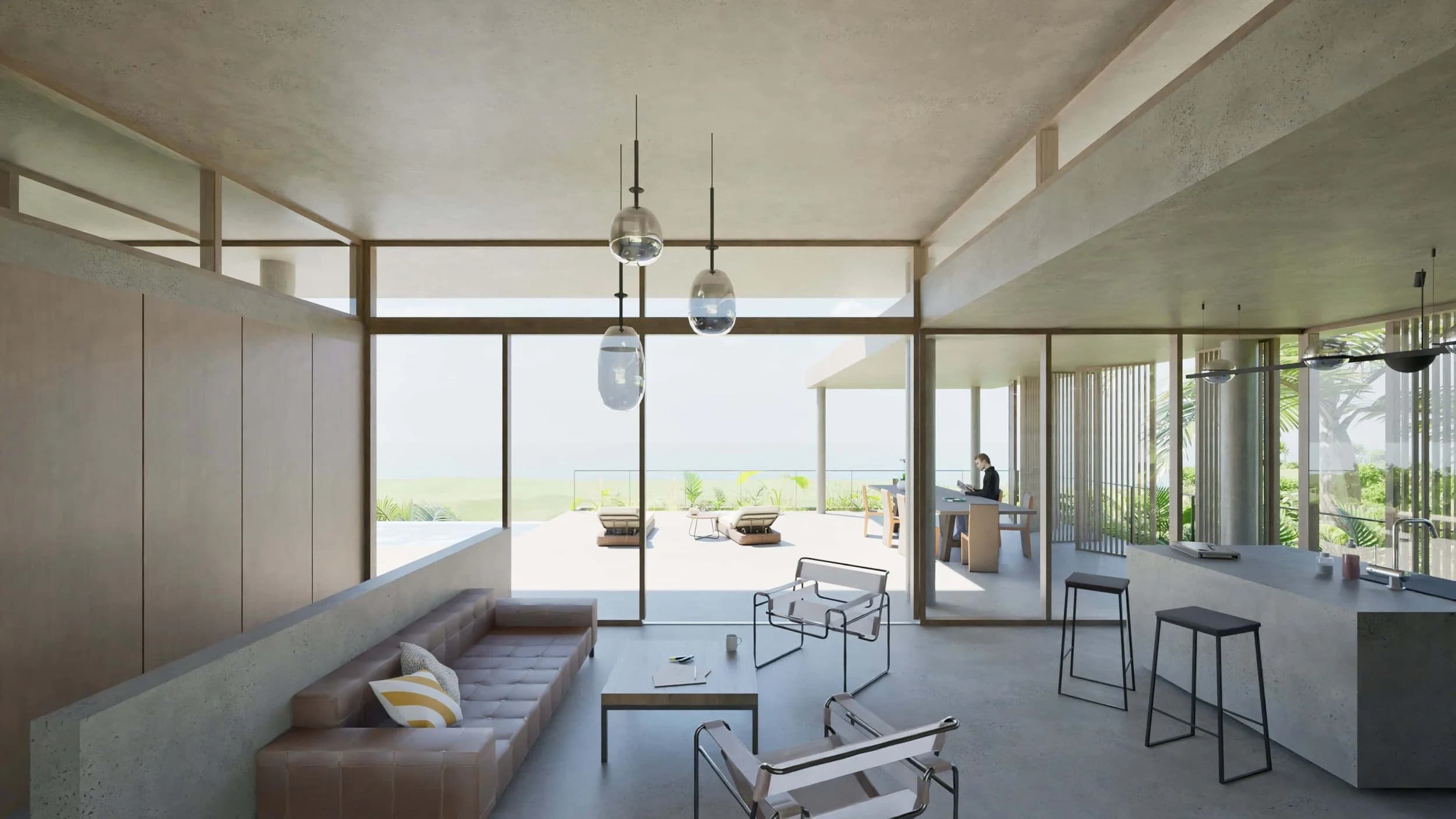
Eco-luxury is often a marketing label without an engineering definition. What the premium actually buys — construction standards, material choices, operating cost, and the site-level framework — and why the math works for the buyer over the life of the villa.
"Eco-luxury" gets used loosely. In Caribbean real estate it sometimes means a thatch roof and a marketing brochure, and not much else. In its honest form it means a specific stack of construction standards, material choices, and operating-cost characteristics that together justify a premium over conventional Caribbean luxury — and that pay the premium back over the life of the villa.
This article walks through where the eco-luxury premium actually goes, what it does, and why the math tends to work for the buyer if the construction is real.
Key Takeaways
- Eco-luxury, done honestly, is an engineering specification — not an aesthetic.
- The construction premium is concentrated in passive design, durable materials, and infrastructure pre-engineering (solar, water, treatment).
- Operating-cost savings — particularly energy and water — compound over decades and offset much of the upfront premium.
- Premium materials at this tier often perform better in the tropical climate than the cheaper imported alternatives, before any sustainability argument.
- The community/site-level premium (environmental license, protected species, native landscape) is the hardest to replicate and shows up clearly on resale.
What does "eco-luxury" actually mean?
A useful working definition: eco-luxury is a villa built to a verifiable environmental specification (license, building guidelines, mandatory equipment standards) at a level of finish and amenity that meets the luxury market.
The two halves matter equally. A traditional luxury villa with no environmental specification is luxury, not eco-luxury. An eco-villa with budget finishes and basic amenities is sustainable, not luxury. The honest definition requires both.
The practical test is whether the environmental commitments are documented and binding (in license conditions, building guidelines, contracts) or just claimed. Anything claimed in a brochure but not enforceable should be discounted by the buyer.
Where does the construction premium actually go?
A buyer paying an eco-luxury premium over conventional Caribbean construction is typically paying for three categories of upgrade.
Passive design and structure
The first is in the building's bones — the orientation, the ceiling heights, the roof assembly, the structural core. At Sienna, this means reinforced concrete structural frames, coconut-fiber-and-gravel roof assemblies that outperform standard concrete roofs in this climate, ocean-breeze-optimized orientation, and screened terraces that shade glazing while preserving ventilation.
This category does not photograph well. It is invisible once construction is done. But it is where most of the energy savings and most of the storm resilience actually come from. A villa with poor passive design and excellent equipment will underperform a villa with excellent passive design and average equipment, over almost any time horizon.
Pre-engineered systems infrastructure
The second category is infrastructure that is engineered into the build rather than retrofit later. Solar-ready roof and electrical infrastructure (orientation, load capacity, conduit pathways) is the most visible example. Pre-run conduit for EV charging, full pluvial drainage connection, and and an individual wastewater treatment system built into every villa are others.
The premium here pays for itself in two ways. First, the retrofit cost when an owner does activate solar or install EV charging is materially lower than the equivalent retrofit on a conventional villa. Second, the systems work together — a villa where the solar array, battery sizing, and roof orientation were all designed together performs differently than one where they were stitched on afterward.
Mandatory equipment standards
The third category is equipment performance. Every villa ships with LED lighting throughout, remote-controlled ceiling fans in the living areas, bedrooms, kitchen and terrace, an electric tankless water heater, and salt chlorination on the pool. A/C outlets are pre-installed in every room, while the mini-split units themselves are an optional upgrade — cooling gets added where an owner actually wants it, rather than fitted by default.
These are operating-cost decisions encoded into the construction stage. The cumulative effect over 20-30 years of ownership is meaningful, particularly in the Caribbean climate where cooling load is constant and water heating is a year-round expense.
Where do you make the premium back?
The honest case for eco-luxury is not aspirational — it is financial. The premium gets paid back in three places.
Operating cost
Energy and water are the two big lines. A villa with strong passive cooling, solar-ready infrastructure, and mandatory low-consumption equipment runs at materially lower monthly operating cost than a conventional Caribbean villa at the same scale. Owners typically report utility costs noticeably below comparable local stock.
Solar activation is where the math gets interesting. Sienna villas are pre-engineered for a 6-10 kW PV array. With Dominican electricity rates and Caribbean sun-hours, payback windows are shorter than most US or European markets — the International Energy Agency tracks Caribbean solar irradiance among the strongest in the Western Hemisphere.
Resale stability
The Caribbean buyer pool is more sophisticated than it was a decade ago. Buyers underwrite construction quality and environmental compliance more carefully now, particularly post-Dorian. A villa with a verifiable environmental license, documented construction standards, and a stable HOA framework commands a resale premium over conventional stock — and a stability premium during weaker market periods.
The reverse also matters. Caribbean developments without environmental licenses, or with shortcuts in their permitting, face increasing regulatory and insurance pressure as Dominican environmental enforcement tightens. The eco-luxury villa's premium is, in part, an insurance against being on the wrong side of that tightening.
Rental performance
Eco-conscious travel is the fastest-growing segment of Caribbean tourism. Verifiable environmental credentials position a villa in the part of the rental market that earns rate premiums and higher year-round occupancy. Knight Frank's wealth research has tracked rising buyer attention to sustainability in prime markets, and the rental data follows the same direction.
For a buyer who plans to rent the villa part of the year through the project's rental program, this is not a hypothetical premium — it shows up in average daily rate and in occupancy.
What about premium materials and finishes?
The materials side of the eco-luxury premium is straightforward: at this tier, the premium materials often perform better in the tropical climate than the cheaper imports, before any sustainability argument.
Specific examples:
- Locally quarried stone and aggregate. Lower transport carbon and supply-chain risk; structurally equivalent to imports; visually consistent with the region.
- Slow-growth tropical hardwoods (FSC-certified Caribbean sources). Durable in this climate in ways imported softwoods are not.
- Native plant fibers (coconut, sisal) in insulation and finishes. Naturally pest-resistant in the tropics, better thermal performance, lower embodied carbon.
- Salt-system pool equipment. Lower chemical input, lower maintenance, materially different swimming experience.
A buyer paying for these materials is paying for performance in the climate, not just sustainability.
What's the community/site-level premium?
The hardest part of the eco-luxury premium to replicate at the villa level is the site itself. At Sienna this includes:
- 67% permanent green space, locked by Environmental License N° 0644-26
- 30m Arroyo Seco protection strip with full preservation of riparian vegetation
- Three Dominican Red List species (Palma real, Gri-gri, Juan Colorado) individually georeferenced and protected
- An individual wastewater treatment system for every villa
- Permeable hardscape across all parking and pathways (license condition)
- Native-only landscape palette in common areas
A villa-level upgrade cannot replicate a site-level commitment. This is the part of the eco-luxury premium that shows up most clearly on resale — and the part that, when present, distinguishes the genuine eco-luxury market from the marketed version.
The shorter version
Eco-luxury done honestly is an engineering spec, not an aesthetic. The premium pays for passive design, infrastructure pre-engineering, and equipment standards — and gets paid back in operating cost, resale stability, and rental premium. The site-level commitments are what distinguish the real version of the category from the marketed version.
To see the construction-side detail in one place, the sustainable-living pillar covers it end-to-end. To see how the spec translates into a finished villa, arrange a Discovery Tour or browse the five villa models.
Stay in the loop
Have questions about this?
Talk to our sales team directly — we'll answer on WhatsApp or by phone.
Written by
Sienna Terrenas Editorial Team
The Sienna Terrenas editorial team covers buying, owning, and living in Las Terrenas, Dominican Republic — from the purchase process and CONFOTUR tax strategy to villa construction and Caribbean community life, drawing on the team's on-the-ground experience in the area. Meet the Sienna Terrenas team.


