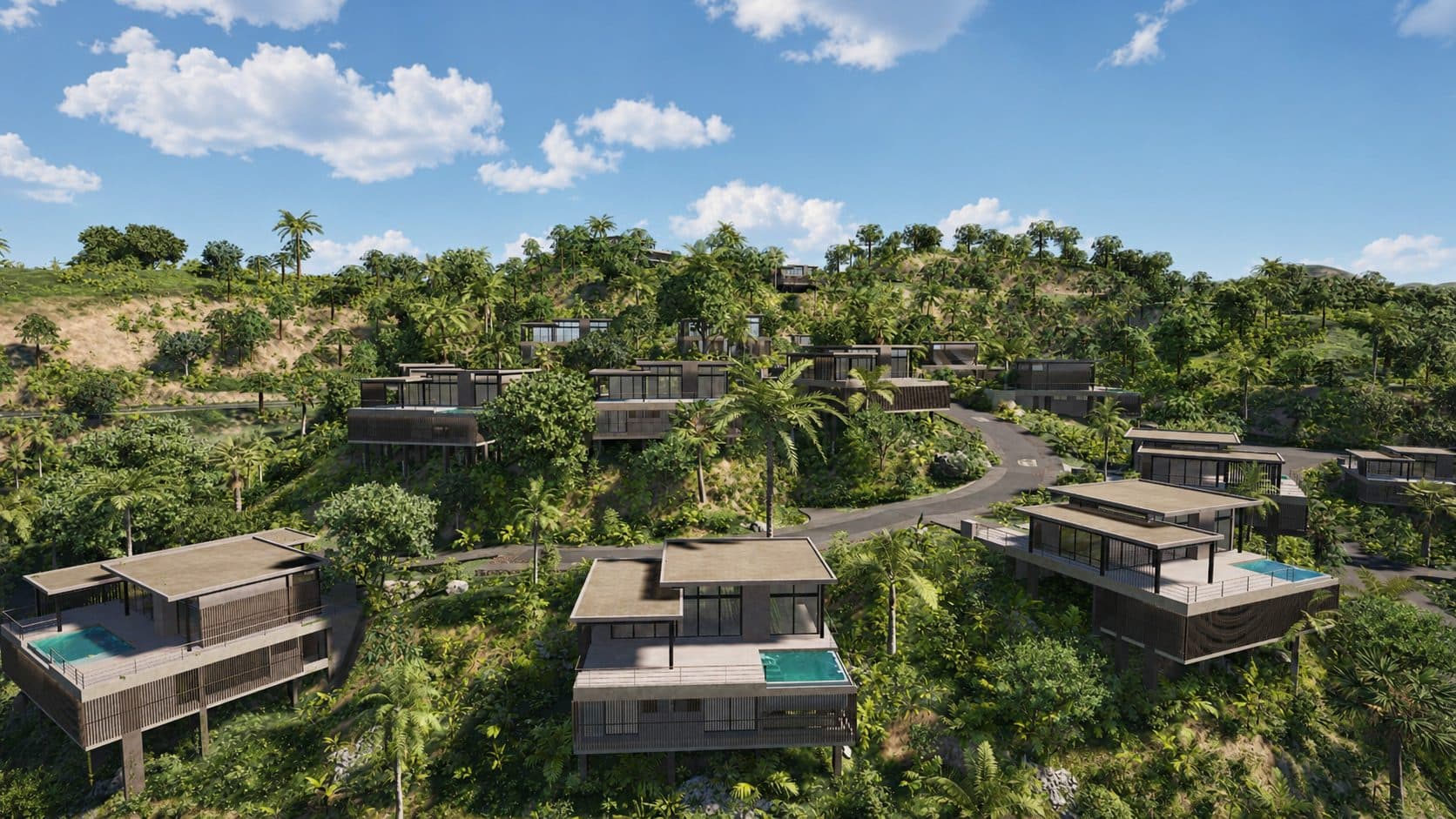
What "hurricane-resistant" actually means in the Caribbean — roof systems, impact glazing, structural cores, and site-level resilience. The construction details that decide whether a villa is standing the morning after.
Most "hurricane-ready" marketing in Caribbean real estate is a paragraph of soft language about reinforced construction. The reality is that the difference between a villa that survives a Category 3 storm and a villa that does not is decided by four or five specific details — roof attachment, glazing rating, structural core, and site geometry — and almost nothing else.
This article walks through what hurricane-resistant actually means in the Dominican context, what the failure modes are, and how Sienna's building guidelines address each of them.
Key Takeaways
- The Caribbean averages roughly a dozen named storms per season; the Dominican north coast sits on the historical track but is partially shielded by the Cordillera Septentrional.
- Roof, windows, and doors are the three failure points in tropical storm damage — get those right and the structure usually holds.
- Sienna villas use reinforced concrete structural cores and poured concrete roof slabs; reinforced glazing and exterior storm shutters are offered as upgrades.
- Site geometry matters as much as villa detailing — Sienna's footprint follows the topography, preserving natural windbreaks and avoiding the mass earthworks that worsen runoff.
- Verifiable construction standards translate into materially better insurance terms and stronger resale value in a market where buyers increasingly underwrite storm risk.
What does "hurricane-resistant" actually mean?
A hurricane-resistant home is one engineered to withstand sustained wind loading, impact from wind-borne debris, and the secondary effects (water intrusion, structural fatigue, roof uplift) that follow. There is no single certification number in the Dominican Republic the way Florida has a Miami-Dade impact rating, but the engineering principles are the same.
The four pillars are:
- Roof attachment and geometry — the roof must be attached to the structure, not just to itself
- Glazing and openings — windows and doors are the most common breach points; once a window blows in, internal pressure spikes and the roof can lift
- Structural core — the load path from foundation to roof must be continuous and adequately reinforced
- Site-level mitigation — drainage, vegetation, and topography that absorb storm impact instead of channeling it
Most Caribbean storm damage is not catastrophic structural failure. It is the cascade that starts when one of these four fails: a window blows in, internal pressure rises, the roof partially lifts, water gets into the envelope, and what would have been a clean event becomes a multi-month repair.
The Caribbean's hurricane reality
The Atlantic basin produces roughly a dozen named storms in a typical season, with peak activity August through October. The Dominican Republic sits on the historical track, but the Cordillera Septentrional — the mountain range that runs along the north coast above Las Terrenas — partially shields the Samaná peninsula from the worst north-track storms. Major direct hits are uncommon historically but not impossible.
The right design posture is to assume a serious storm event during the life of the villa and engineer for it.
How does Sienna build for storms?
The Sienna villa specification, as set in the project's building guidelines, addresses each of the four pillars:
Structural core: reinforced concrete
Every villa is built around a reinforced concrete structural frame — concrete columns and slabs, with continuous reinforcement from foundation to roof beam. This is the standard for Dominican construction at this tier, and it is fundamentally different from the wood-frame construction common in much of North America. The structure is heavier, the load path is continuous, and the wind-uplift resistance is materially higher.
Roof: engineered for sustained loading
The villa roof systems are designed for sustained tropical wind loading, with hurricane-grade fastening between the roof structure and the concrete frame below. The insulation layer uses coconut fiber and gravel — a Caribbean-native material assembly that, beyond its thermal performance, adds mass and helps anchor the roof against uplift. Mass and continuous attachment, not lightness, is the right answer in a hurricane zone.
Glazing and openings
Standard glazing is aluminium and glass. For owners who want a harder envelope on exposed elevations, reinforced frames and glass, and exterior shutters, are offered as upgrades. The principle is consistent: do not let the envelope breach.
Doors and patio systems
Patio doors and main entries are the second most common breach point after windows, especially on Caribbean villas where large folding or sliding patio systems are common. Sienna's sliding systems are aluminium and glass as standard, with reinforced frames and glass, and exterior shutters, available as upgrades.
What about the site itself?
Villa-level detailing matters, but site-level decisions matter as much. Sienna's framework includes several site-level resilience features that an owner does not see directly but benefits from in a storm event:
- Footprint follows topography. No mass earthworks. Villas step with the slope, preserving the natural contour and existing tree canopy. Mass site-flattening — common in Caribbean development — strips out the natural windbreaks and worsens stormwater runoff.
- Native species preservation. Three Dominican Red List species — Palma real, Gri-gri, and Juan Colorado — are georeferenced on site and individually protected. Mature native canopy is a meaningful wind buffer that no engineered solution replicates.
- Permeable hardscape. All parking surfaces are built in permeable materials — eco-pavers, gravel, grass-concrete. This is a license condition under Environmental License N° 0644-26, but the practical effect during a storm is that stormwater absorbs rather than concentrating into damaging runoff.
- Drainage to the community system. No villa discharges to streets, neighbors, or natural watercourses. The project's pluvial drainage network handles storm volumes the way local Dominican drainage cannot.
These are the boring details that decide outcomes. The visible architecture matters less than the geometry of the site it sits on.
What does this mean for insurance and resale?
The insurance market in the Caribbean has tightened materially over the last decade. Insurers underwrite storm risk explicitly, and they increasingly differentiate on construction quality. A villa with verifiable hurricane detailing — impact glazing on the windward face, reinforced concrete frame, engineered roof — commands materially better premium terms than the regional average.
On resale, the same pattern holds. Caribbean buyers are more sophisticated than they were ten years ago. When a buyer asks what your roof spec is or whether your glazing is impact-rated, the right answer is a specific one — and a project where those answers are written into the building guidelines, not promised in a brochure, carries a premium.
The broader picture: Knight Frank's wealth research has tracked rising buyer attention to climate resilience in prime markets, and the Caribbean is one of the regions where that attention is concentrating fastest.
The shorter version
Hurricane resistance in the Caribbean is a matter of four details done well: roof attachment and geometry, glazing and openings, structural core, and site-level mitigation. Sienna addresses the structural pillars as standard — reinforced concrete from foundation to roof slab — with reinforced glazing and exterior shutters available for owners who want to go further.
If you want the construction-side detail in one place, the sustainable-living overview covers it end-to-end. To walk a finished villa and see how the spec translates, arrange a Discovery Tour or browse the villa models.
Stay in the loop
Have questions about this?
Talk to our sales team directly — we'll answer on WhatsApp or by phone.
Written by
Sienna Terrenas Editorial Team
The Sienna Terrenas editorial team covers buying, owning, and living in Las Terrenas, Dominican Republic — from the purchase process and CONFOTUR tax strategy to villa construction and Caribbean community life, drawing on the team's on-the-ground experience in the area. Meet the Sienna Terrenas team.


