Solar, rainwater, septic, internet — what off-grid actually means in the Dominican Republic, what it costs, and why "off-grid-ready" beats "fully off-grid" for almost every Caribbean buyer.
Off-grid living in the Dominican Republic is more practical than most North American or European buyers expect — and more nuanced than the YouTube version suggests. The sun is plentiful, the year-round growing season is real, and rural land is comparatively affordable. But going fully off-grid in the tropics has its own failure modes — humidity, salt corrosion, hurricane season — and the smart move for most buyers is not full off-grid but a well-designed hybrid.
This guide walks through what each "off-grid" subsystem actually looks like in the DR, what the realistic costs are, and where the tradeoffs sit.
Key Takeaways
- The Dominican Republic averages roughly eight hours of usable sunlight per day, which makes residential solar one of the most economic Caribbean energy plays.
- Fully off-grid is achievable but materially more expensive than "off-grid-ready" — pre-engineered for solar and rainwater, grid-connected as backup.
- Water, not power, is the harder problem on the north coast. Plan for either a deep well or a rainwater + treatment system, not municipal supply alone.
- Hurricane season changes the math. Battery banks, water tanks, and PV arrays all need storm-rated mounting and protected enclosures.
- The most defensible setup for a Caribbean villa is grid-tied solar with battery backup, a treated well or rainwater system, on-site septic, and a satellite internet failover.
What does "off-grid" actually mean in the Dominican Republic?
Off-grid usually implies four separate systems: power, water, sewage, and connectivity. In rural Dominican Republic, "off-grid" rarely means all four — it usually means some of them.
The Dominican grid (EDENORTE on the north coast) is reliable in the major towns and patchy in the hills above them. Cuts happen, especially in the rainy season. That has trained Dominican households to be partially self-sufficient: cisterns, inverters, and gas tanks are standard, not exotic. So "off-grid-curious" in the DR is much closer to the local baseline than it would be in Toronto or Berlin.
A useful framing: do not ask whether you go off-grid. Ask which of the four subsystems you can productively decouple from the public utility, and at what cost.
Power: what can you realistically run on solar?
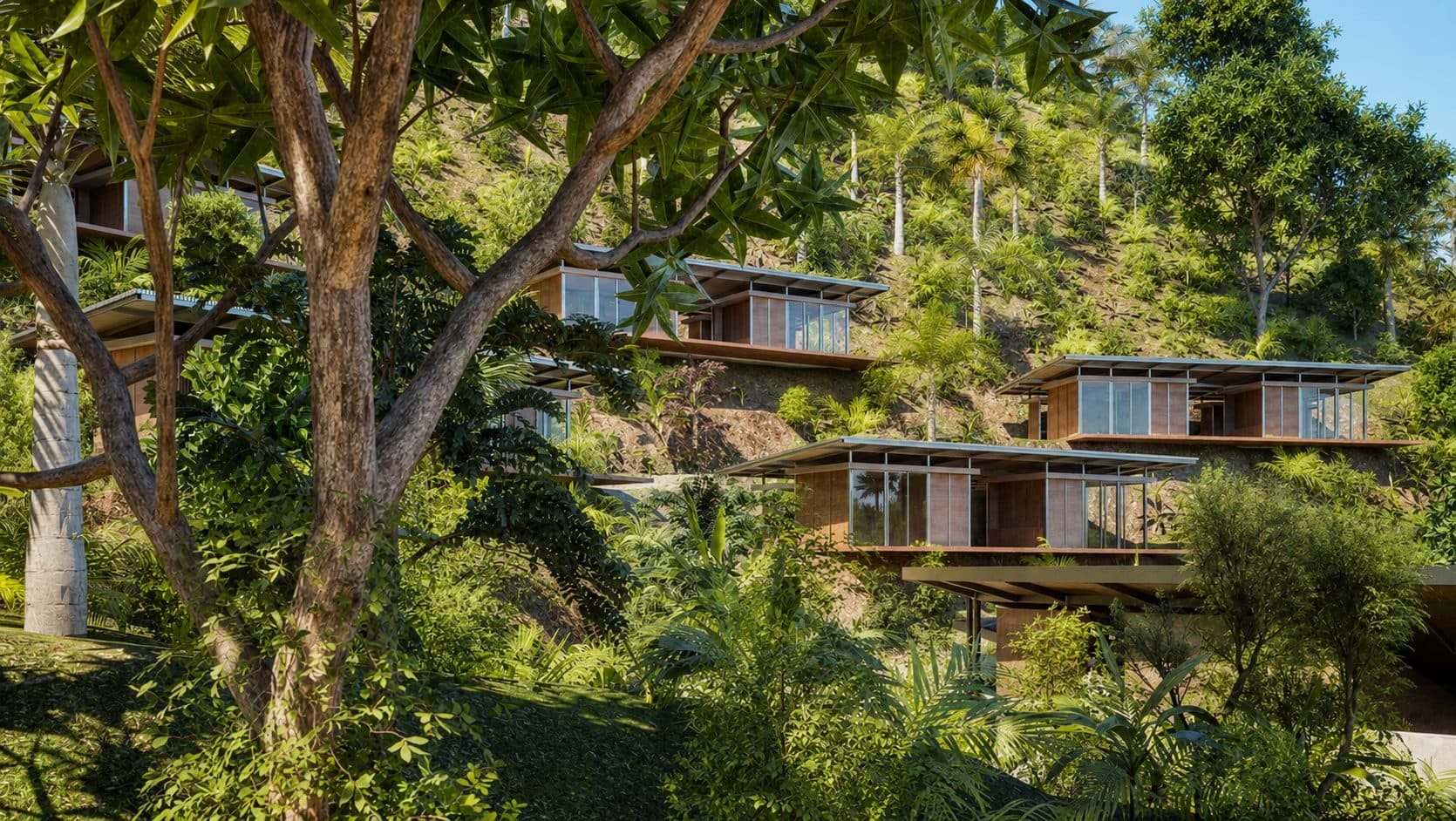
A modern Sienna-spec villa — three bedrooms, salt-system pool, full appliance set, with mini-split A/C added as an upgrade — can run almost entirely on solar with the right sizing. The reasons are climate-specific:
- The Dominican north coast averages roughly eight usable solar hours per day, year-round. Higher than nearly anywhere in the continental US or Europe — the International Energy Agency tracks Caribbean solar irradiance among the strongest in the Western Hemisphere.
- Roof orientation and pitch on Sienna villas are pre-engineered to accept a PV array, including conduit pathways, structural roof load capacity, and inverter placement. Activation is the owner's call; the infrastructure is not. (See the construction practices on the sustainable-living pillar for the build-side detail.)
- The villas ship with low-consumption equipment as standard — LED lighting throughout, remote-controlled ceiling fans in every main room, and an electric tankless water heater that heats only the water you draw. The fans carry much of the cooling load, and A/C is added only where an owner wants it. Lower baseline load means a smaller array goes further.
A 6 to 10 kW residential PV system, with a battery bank sized for evening loads, is a typical configuration for a fully decoupled three-bedroom villa. Hybrid systems — grid-tied with battery backup — are cheaper and arguably more resilient for storm season.
Water: the harder problem than you think
Power gets the headlines. Water is where most Caribbean off-grid projects underperform.
Municipal water in Las Terrenas exists but is not uniformly reliable. Off-grid water in the DR usually means one of three options:
| Source | What it looks like | Caveats |
|---|---|---|
| Deep well | Drilled bore, 30-80m, electric pump | Requires testing, treatment, storm-rated pump |
| Rainwater harvest | Roof catchment, first-flush diverter, cistern | Needs treatment; supply seasonal |
| Combined | Well as base, rainwater as supplement | Highest reliability, highest capex |
All three need filtration and either UV or chlorine treatment to be potable. The combined approach is what most well-designed Caribbean villas land on, because it gives you a buffer when one source has a bad month.
At Sienna specifically, every villa is built with its own individual wastewater treatment system, engineered per lot and included in the villa. That removes one of the four "off-grid" subsystems from your decision tree.
What about sewage and waste?
In rural DR, a properly engineered septic system with a leach field is the default. It is reliable, well-understood by local contractors, and inexpensive to maintain. The honest tradeoff is groundwater protection — leach fields done badly can contaminate a well.
Sienna's per-villa treatment is one of the reasons the project qualifies under the Dominican Environmental License framework — the Ministry of Environment maintains the regulatory framework that licensed projects must follow. For an owner, the practical effect is one less subsystem to engineer, monitor, and replace.
Connectivity: the modern dealbreaker
If you cannot work from your villa, "off-grid" is just camping. Las Terrenas has fiber service in town (Claro, Altice) and microwave service in the hills. Starlink works as a failover; many remote workers in Samaná use it as their primary connection.
Plan for both. Fiber when it's there, satellite when it isn't.
Cost: what should you actually budget?
Honest numbers are hard to give without a specific spec, but here are working ranges for a Caribbean three-bedroom villa setup. Treat these as planning ranges, not quotes.
- Grid-tied solar with battery backup (6-10 kW + 10-15 kWh storage): a meaningful five-figure outlay, with payback measured in low single-digit years given the strong sunlight and Dominican electricity rates.
- Deep well with treatment: middle five figures, plus annual filter and UV-lamp replacement.
- Rainwater system with cistern: depending on roof catchment area, low to middle five figures, plus treatment.
- Backup connectivity (Starlink): low recurring cost; hardware is one-time.
For most buyers, the right starting point is not "fully off-grid." It is "off-grid-ready" — meaning the villa is engineered so that any subsystem can be decoupled later, at lower retrofit cost, when the owner is ready.
Where off-grid makes sense — and where it doesn't
Going fully off-grid makes sense when:
- The grid connection cost would be high (remote land, distant from the line)
- The owner intends to be on-site year-round and wants energy and water independence
- The site has the storm-protected geometry to mount and protect the systems
It makes less sense when:
- The grid is already at the property line
- The owner is non-resident — there is operational complexity in maintaining off-grid systems from abroad
- Storm exposure makes redundancy (grid + solar + battery) safer than solar alone
The Sienna approach — and our recommendation for most buyers — is grid-tied solar with battery backup, treated well or rainwater, on-site or community treatment for sewage, and a satellite backup for connectivity. You get most of the resilience and energy economics of full off-grid, with less risk during storm season and less ongoing maintenance overhead.
The shorter version
The Dominican Republic is one of the better Caribbean markets for off-grid or off-grid-adjacent living, mainly because the sun is generous, land is affordable, and partial self-sufficiency is already part of the local norm. The smart play, in our experience, is to be engineered for full decoupling but to stay hybrid in practice. That setup survives storm season, simplifies your life as a non-resident owner, and still captures the operating-cost benefits of solar and rainwater.
Want to see how a Sienna villa is pre-engineered for this? Arrange a Discovery Tour, or read the sustainable-living overview for the full construction-side detail.
Stay in the loop
Have questions about this?
Talk to our sales team directly — we'll answer on WhatsApp or by phone.
Written by
Sienna Terrenas Editorial Team
The Sienna Terrenas editorial team covers buying, owning, and living in Las Terrenas, Dominican Republic — from the purchase process and CONFOTUR tax strategy to villa construction and Caribbean community life, drawing on the team's on-the-ground experience in the area. Meet the Sienna Terrenas team.


