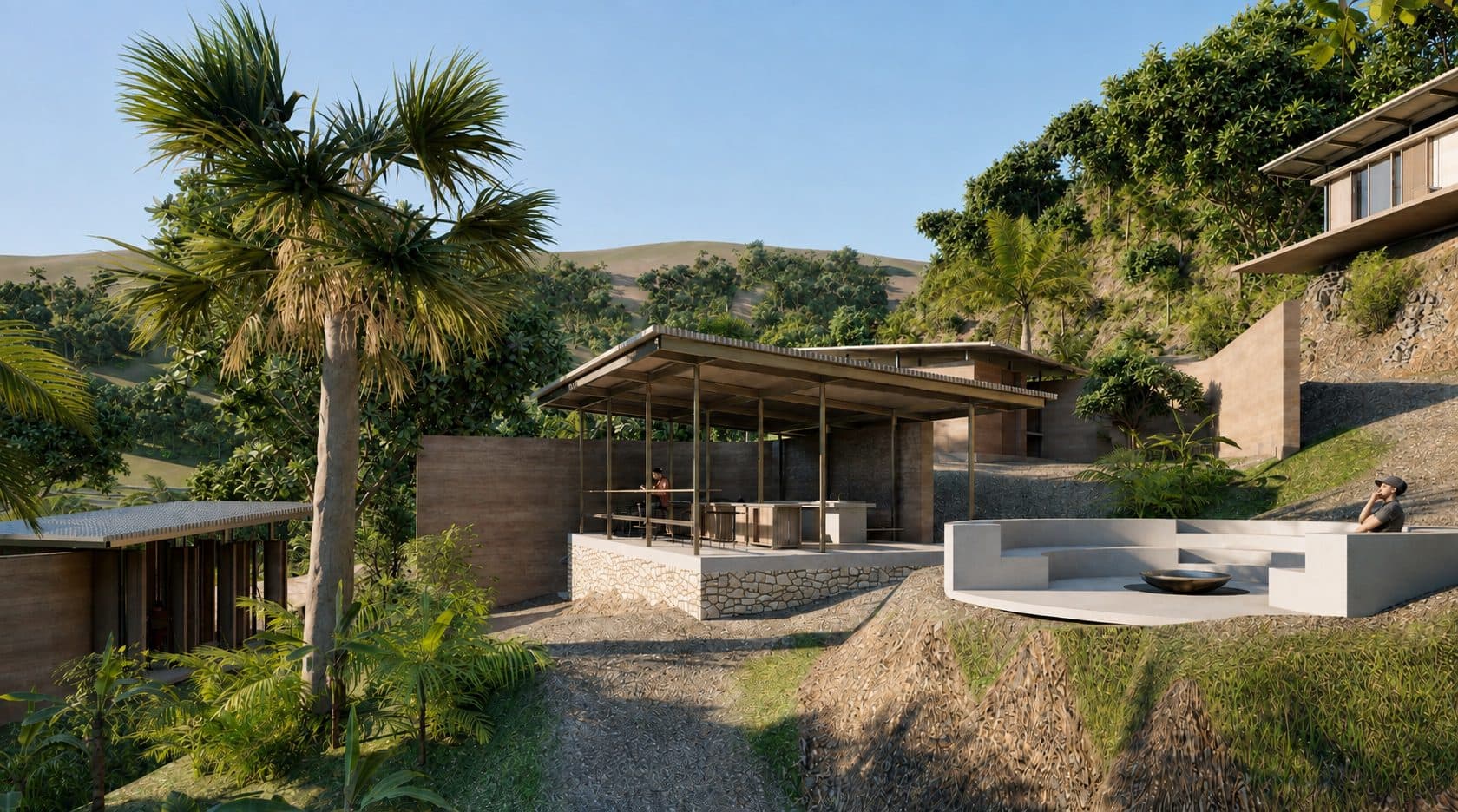
Green building certifications like LEED do more than signal sustainability — they directly affect resale value, rental yields, and operating costs. Here's what each certification means for buyers in Las Terrenas.
Green building certifications are independently verified quality benchmarks that confirm a property meets specific standards for energy efficiency, materials, water use, and indoor air quality. For buyers considering sustainable construction in the Caribbean, these certifications translate directly into lower operating costs, stronger resale values, and a more defensible investment thesis.
Key Takeaways
- LEED and equivalent certifications provide third-party verification that a property performs to measurable efficiency standards — not just marketing claims
- Certified green buildings typically command higher resale premiums and attract more discerning rental tenants
- Certifications cover five core areas: energy, materials, water, indoor air quality, and site impact
- In the Caribbean context, standards for solar readiness, water management, and storm resilience matter as much as conventional LEED categories
- Sienna's sustainable construction framework addresses all five areas, with locally sourced materials where practical and solar-ready infrastructure on every property
What Is a Green Building Certification — and Why Does It Matter?
Think of a green building certification the way you'd think of an energy rating on a car or an organic label on food. It tells you that an independent body has verified the product meets a defined standard — rather than relying on the developer's own marketing language.
In real estate, this distinction matters enormously. "Eco-friendly" and "sustainable" are unregulated terms; any developer can use them. A certification cannot be self-awarded. It requires documentation, third-party audits, and ongoing compliance.
The Certifications Most Relevant to Caribbean Real Estate
Several frameworks appear across Caribbean and Latin American sustainable construction:
- LEED (Leadership in Energy and Environmental Design) — the most globally recognised system, administered by the U.S. Green Building Council. LEED rates buildings across energy, water, materials, indoor environment, and site criteria, awarding Certified, Silver, Gold, or Platinum tiers.
- EDGE (Excellence in Design for Greater Efficiencies) — an IFC/World Bank programme designed for emerging markets, requiring at least 20% improvement in energy, water, and embodied energy in materials versus a baseline building.
- EarthCheck — the leading science-based certification for sustainable tourism and hospitality developments, widely used across Caribbean resort and residential-resort properties. EarthCheck's benchmarking programme covers operational performance alongside construction standards.
- National and regional schemes — the Dominican Republic does not yet operate a standalone national certification body, but developments applying LEED or EDGE criteria gain competitive differentiation in a market where most projects carry no third-party verification at all.
How Energy Ratings Affect Your Operating Costs (and ROI)
What does an energy rating actually mean for your wallet?
A property's energy rating — whether expressed in a LEED credit score, an EDGE percentage improvement, or a simple kilowatt-hour-per-square-metre figure — determines how much you spend on electricity and cooling every month. In the Caribbean, where air conditioning can represent the single largest household operating cost, this is not a marginal consideration.
Solar Readiness as a Baseline Standard
At Sienna, every lot and villa includes solar-ready infrastructure — conduit, panel mounts, and inverter space — so buyers can integrate photovoltaic systems without retrofit costs. Properties designed with passive cooling (cross-ventilation, roof overhangs, natural shading) reduce the base cooling load before solar is even factored in.
According to the International Renewable Energy Agency (IRENA), solar PV costs in the Caribbean have fallen substantially over the past decade, making solar economics increasingly compelling for property owners who front-load the infrastructure investment at construction stage rather than retrofitting later.
Lower Operating Costs
Sienna's design is aimed at lower running costs than a conventionally built villa of equivalent size in Las Terrenas, through building orientation, insulation standards, native landscaping that reduces heat island effect, and the solar-ready systems noted above. Over a 10-15 year hold period, that operating cost differential compounds meaningfully against your net rental income.
Material Certifications: Why "Local and Sustainable" Is a Verifiable Claim
Does it actually matter where building materials come from?
From an investment standpoint, yes — for two reasons. First, locally sourced materials carry lower embodied carbon and are typically better adapted to tropical climate performance (humidity resistance, thermal mass). Second, supply chains for locally sourced materials are shorter and more resilient to the import disruption that affects Caribbean construction projects built entirely on imported goods.
What Local Sourcing Means at Sienna
Sienna sources building materials locally wherever practical: stone, timber, concrete aggregates and finishing materials come from Dominican suppliers. Mechanical, electrical and glazing systems draw on international suppliers selected for performance specifications relevant to tropical environments.
Embodied Carbon and the Buyer's Due Diligence Checklist
When comparing developments, ask for a materials schedule and request evidence of supplier provenance. A credible sustainable developer will be able to share this documentation; one relying on marketing language alone will not.
Key certifications to look for on materials:
- FSC (Forest Stewardship Council) for timber — verifies sustainable forest origin
- Cradle to Cradle for manufactured products — assesses full lifecycle impact
- Low-VOC certification for paints, adhesives, and finishes — directly linked to indoor air quality (see below)
Water Standards: A Critical Caribbean Differentiator
Is water infrastructure really a differentiating investment factor in the Caribbean?
More than most buyers realise. Municipal water supply reliability varies across Dominican coastal communities, and properties with independent water management systems are materially more resilient — and more rentable — than those dependent entirely on municipal infrastructure.
Water Management
Sienna's water management centres on individual wastewater treatment — each villa treats its own on site rather than piping everything to one central plant — paired with 70% native plant landscaping, which requires significantly less irrigation than non-native ornamental planting.
For a rental property, this matters: a property that maintains lush, well-irrigated grounds during dry season without running up water bills is a better-presented and lower-cost asset.
LEED's Water Efficiency Credits
Under LEED's Water Efficiency category, buildings earn credits for reducing potable water consumption, using native landscaping, and implementing efficient irrigation. A property achieving LEED Water Efficiency credits has third-party confirmation that its water systems perform to a verified standard — not an assertion from a sales brochure.
Indoor Air Quality: The Certification Factor Buyers Overlook
Why does indoor air quality appear in a real estate investment article?
Because poor indoor air quality — caused by off-gassing from synthetic materials, inadequate ventilation, or mould from poor humidity management — is a leading cause of guest complaints in tropical rental properties, and a growing liability consideration as wellness-conscious travellers become a dominant segment of the luxury short-term rental market.
What Certifications Verify
LEED's Indoor Environmental Quality (IEQ) category covers:
- Minimum ventilation performance
- Construction indoor air quality management
- Low-emitting materials (paints, adhesives, carpets, composite wood)
- Thermal comfort and daylight access
A villa built to IEQ standards uses low-VOC finishes throughout, is designed with cross-ventilation rather than sealed mechanical air systems, and has construction-stage protocols preventing mould formation during the build. This is a specification difference that is invisible to the eye but shows up in guest reviews and property longevity.
How Certifications Affect Resale Value
Does green certification actually translate into a higher sale price?
The evidence from global markets is consistent. JLL's research on sustainable real estate documents a measurable "green premium" in sale prices and rental rates for certified versus non-certified comparable properties, with the premium growing as buyer awareness of energy costs increases.
In Las Terrenas specifically, the market is still developing its certification literacy — which means that certified properties stand out clearly in a field where most developments carry no third-party verification. Early movers in certification earn a differentiation advantage that becomes harder to replicate as the market matures.
The Resale Liquidity Argument
Beyond price premiums, certified properties typically attract a broader international buyer pool. Buyers from Germany, Switzerland, France, and Canada — markets that have normalised green building standards domestically — increasingly filter for verified sustainability credentials when evaluating overseas property. A LEED or EDGE-certified villa in Las Terrenas speaks a language those buyers already understand and trust.
Ready to see how Sienna's sustainable construction standards stack up against your investment criteria? [Explore your ROI and investment options]To see how these principles are built into Sienna, from solar and water to the food forest, visit Sustainable Living at Sienna.
Certifications vs. Marketing Claims: A Practical Comparison
| Claim Type | Verifiable? | Who Checks? | Example |
|---|---|---|---|
| "Eco-friendly" / "green" | ❌ No | Nobody | Developer marketing |
| "Solar-ready infrastructure" | ✅ Yes | Buyer inspection / specs | Sienna standard |
| LEED Certified (any tier) | ✅ Yes | USGBC third-party auditor | Formal certification |
| EDGE Certified | ✅ Yes | IFC-accredited verifier | Formal certification |
| EarthCheck Certified | ✅ Yes | EarthCheck assessors | Formal certification |
| Local material sourcing | ✅ Yes | Materials schedule / audit | Documented supply chain |
| "Sustainable construction" | ❌ No | Nobody | Developer marketing |
The practical takeaway: ask every developer you're comparing for documentation, not descriptions.
Frequently Asked Questions
Does LEED certification cost more to build?
Yes, achieving LEED certification typically adds to upfront construction costs — estimates in the industry range from marginal (for projects designed sustainably from the outset) to a more meaningful premium for full Platinum-level certification. The key financial question is not whether it costs more to build, but whether the operational savings, resale premium, and rental positioning offset that cost over your hold period. For most long-term buyers in Las Terrenas, the math favours certified construction.
Can I get a certified green property in the Dominican Republic?
Yes. While the Dominican Republic does not have a local national certification body, LEED and EDGE both operate internationally and can certify projects in the DR. An internationally certified project in Las Terrenas carries the same credential as one in Florida or Europe — the standard is global, not country-specific.
How does green certification affect my rental income?
Two mechanisms: first, lower operating costs directly improve your net yield (the same gross rental income yields more net after lower utility and maintenance bills). Second, wellness-oriented and sustainability-conscious travellers — a growing segment of the luxury short-term rental market — actively filter for eco-credentialed properties, supporting occupancy rates. See our detailed Las Terrenas rental income analysis 2026 for context on the Las Terrenas rental market.
What should I ask a developer about their sustainability claims?
Three questions that separate verified from marketing: (1) Do you have or are you pursuing a third-party certification (LEED, EDGE, EarthCheck)? (2) Can you provide a materials schedule with supplier provenance? (3) What are the projected energy and water costs for this property, and what are they based on? A developer with genuine credentials will answer all three without hesitation.
How does Sienna's sustainability approach compare to other Las Terrenas developments?
Sienna's programme includes solar-ready infrastructure on every property, 70% native plant landscaping, individual wastewater treatment per villa, and locally sourced materials where practical — with construction designed to support LEED-aligned standards. Most Las Terrenas developments carry no documented third-party sustainability framework. The full sustainability overview for Sienna covers the programme in detail.
The Certification Checklist Before You Compare Developments
Before signing anything, run through these questions with every developer you're evaluating:
- Is the project pursuing LEED, EDGE, EarthCheck, or equivalent third-party certification?
- What percentage of materials are locally sourced, and can you document it?
- Does the design include passive cooling features (orientation, overhangs, cross-ventilation)?
- Is solar infrastructure pre-installed or solar-ready on all properties?
- What are the water management systems — wastewater treatment, native landscaping, water storage?
- Are low-VOC finishes and materials used throughout?
- What are the projected utility costs, and are they independently modelled?
- How have comparable certified properties in this market performed on resale?
A developer who can answer every question with documentation is one worth serious consideration. One who deflects to lifestyle photography is telling you something important.
If you'd like to walk through Sienna's responses to each of these questions in detail, schedule a no-pressure consultation with our team — we're happy to share the full technical specifications and let the numbers speak for themselves. You can also explore how our sustainable design features feed into projected returns on our investment ROI page.
Stay in the loop
Have questions about this?
Talk to our sales team directly — we'll answer on WhatsApp or by phone.
Written by
Sienna Terrenas Editorial Team
The Sienna Terrenas editorial team covers buying, owning, and living in Las Terrenas, Dominican Republic — from the purchase process and CONFOTUR tax strategy to villa construction and Caribbean community life, drawing on the team's on-the-ground experience in the area. Meet the Sienna Terrenas team.


