Sustainable construction in the tropics is a different problem than in temperate climates. Seven specific practices — passive design, local materials, water systems, storm detailing, and more — that decide whether a Caribbean villa is actually sustainable or just marketed that way.
Sustainable construction in the tropics is not the same problem as sustainable construction in Switzerland or Vancouver. The climate is hot, humid, and storm-prone; the supply chain is constrained; the standards are evolving. The right answer is a stack of specific practices — passive design, the right materials, durability detailing — not a label or certification.
This guide walks through seven practices that actually decide whether a Caribbean villa is sustainable in any meaningful sense, drawing on the construction standards used at Sienna Terrenas and the broader Dominican eco-development framework.
Key Takeaways
- Tropical sustainable construction is climate-specific — practices that work in Europe often underperform in the Caribbean, and vice versa.
- Passive design (orientation, ventilation, insulation) does more for energy use than any active system added afterward.
- Local materials reduce embodied carbon and supply-chain fragility; the right ones outperform imports in this climate.
- Water management is as important as energy in the tropics; storm-grade detailing protects both the structure and the long-run value.
- Standard low-consumption equipment (LED lighting, remote-controlled ceiling fans, tankless hot water) locks in efficiency that does not depend on owner behavior.
1. Passive design first, active systems second
The biggest sustainability lever in tropical construction is what you do before you turn anything on. Orientation, ventilation, insulation, and shading set the baseline energy load. Once that baseline is wrong, no amount of solar or efficient AC fixes it.
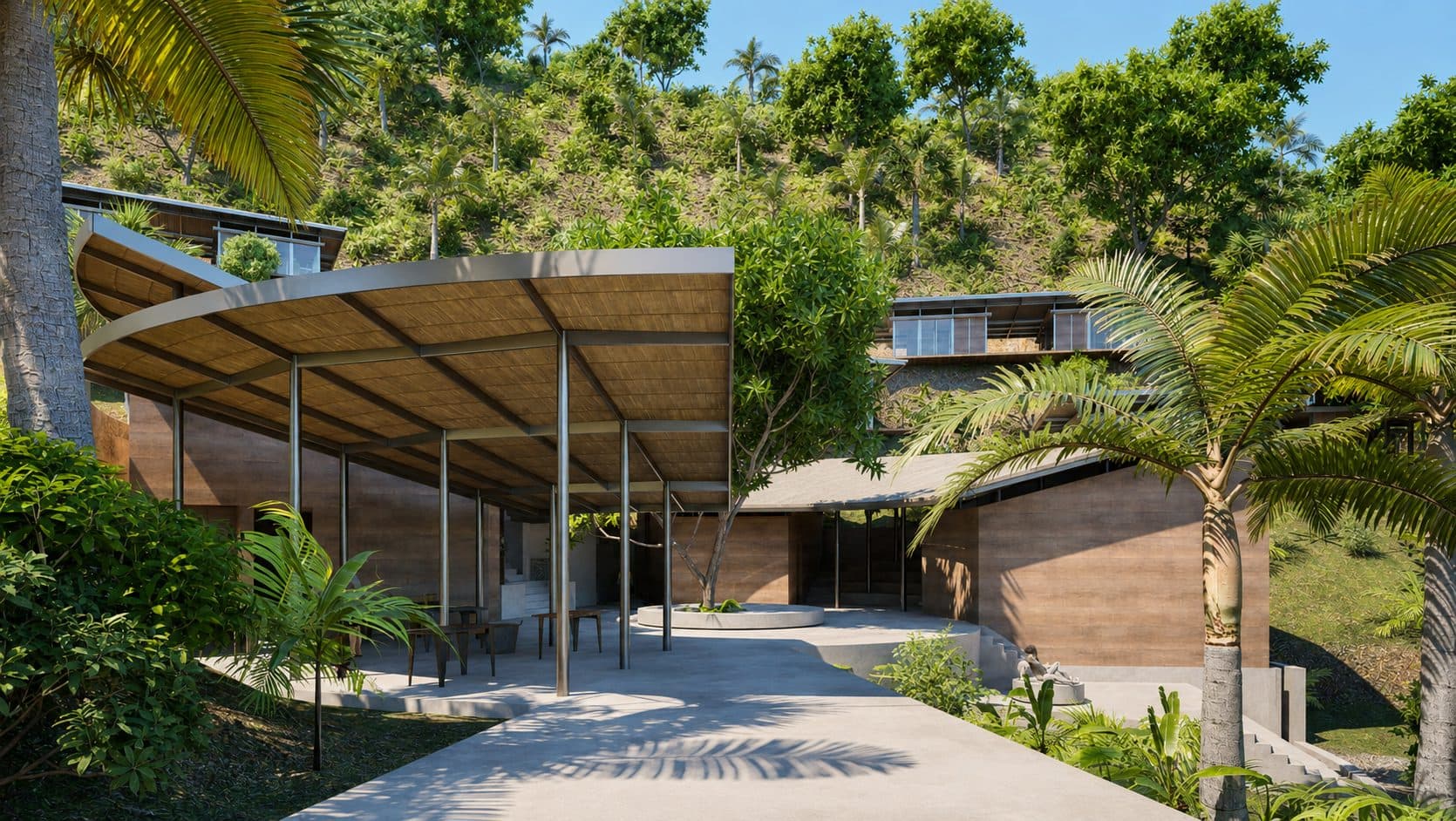
At Sienna, villas are oriented to capture prevailing ocean breezes. Roof assemblies use coconut fiber and gravel layers that outperform standard concrete-only roofs in this climate. Ceilings are high — heat rises, and a six-meter ceiling moves it away from where people are. Eaves and screened terraces shade glazing without blocking ventilation.
The result is a villa where, for most of the year, you do not actually need to run air conditioning during the day. That is the sustainability win that compounds — every degree of passive cooling is a degree the AC does not have to provide.
2. Material selection — local, regional, low-embodied-energy
Heavy materials shipped from Europe or North America carry an outsized carbon cost and a fragile supply chain. The Caribbean construction tradition has always used what is on the island; modern sustainable practice rediscovered that principle.
Three categories matter:
- Native plant fibers for insulation and cladding — coconut fiber being the most established in Dominican construction. Better thermal performance in this climate than imported fiberglass, lower embodied carbon, naturally pest-resistant.
- Regionally quarried stone and aggregate for foundations and landscape. Reduces transport carbon and supports local supply. Dominican stone and gravel are widely used at this tier and structurally equivalent to imports.
- Engineered timber from certified Caribbean sources where structural use is appropriate. Slower-growth tropical hardwoods are durable in this climate in ways temperate softwoods are not.
The framing question is: where does the material come from, and what does that journey cost? Materials that traveled less, almost always, have better sustainability math.
3. Water systems are not optional
Energy gets most of the sustainability headlines. In the tropics, water is the equal-weight problem.
The practices that matter:
- Permeable hardscape. Parking, paths, and driveways built in permeable materials (eco-pavers, gravel, grass-concrete) rather than solid concrete. Rainwater absorbs into the ground instead of concentrating into damaging runoff. At Sienna this is a license condition under Environmental License N° 0644-26.
- Properly engineered wastewater treatment. At Sienna every villa has its own individual treatment system, engineered per lot — many small independent systems rather than one plant the whole community depends on. Done well, that protects groundwater and downstream watercourses and removes the single point of failure.
- Salt-system pools only. Chlorine pools are prohibited under the project framework — for downstream water quality and for the experience of the user. The chemical input drops materially, and the resulting water feels different.
4. Solar-readiness vs. after-the-fact retrofit
Solar in the Caribbean has unusually good economics. Las Terrenas averages roughly eight hours of usable sunlight per day year-round, and Dominican electricity rates make payback windows shorter than in most US or European markets — the International Energy Agency tracks Caribbean solar irradiance among the strongest in the Western Hemisphere.
The sustainable construction practice is not "install solar." It is build solar-ready. Every villa at Sienna is constructed with the structural and electrical infrastructure to install a PV array — roof load capacity, orientation, conduit pathways pre-run, inverter placement. Owner activates when ready. The expensive part — engineering the building to accept solar — is done once, during construction. Retrofitting it later costs materially more.
This is the kind of practice that does not show up on a brochure but compounds over the project's life.
5. Storm and durability detailing
A "sustainable" villa that is half-destroyed in a Category 2 storm is not, on a 30-year horizon, particularly sustainable. Durability is a sustainability metric, and in the Caribbean that means storm detailing.
The specifics: reinforced concrete structural frames with a continuous load path from foundation to roof beam, and poured concrete roof slabs. Reinforced glazing and exterior shutters are offered as upgrades for exposed elevations. The full hurricane-resistant brief is covered in our companion article on Caribbean storm construction, but the principle stands here: durability is sustainability.
6. Mandatory equipment standards, not optional
The cleanest way to lock in efficiency is to mandate it at the building guidelines level, not rely on owner choice. Sienna's framework includes:
- LED lighting throughout — no incandescent or halogen permitted
- A/C outlets pre-installed in every room; high-efficiency inverter mini-split units offered as an upgrade
- Electric tankless water heaters, which heat only the water actually drawn
These are not aspirational targets. They are conditions of the building guidelines. The benefit is that efficiency does not depend on what equipment a particular owner chooses to install — it is set at the construction stage and stays set.
7. Site-level land management
Finally — and this is the practice most often missed — sustainable construction at the villa level only matters if the site itself is managed sustainably. Three site-level practices that actually move the needle:
- Topography-respecting footprint. No mass earthworks. Villas step with the slope, preserving the natural contour and existing tree canopy where possible. Mass site-flattening — common in Caribbean development — destroys exactly the natural systems sustainable construction is supposed to work with.
- Native species preservation and reforestation. Common-area replanting using only native species; ornamental imports prohibited. At Sienna, three Dominican Red List species (Palma real, Gri-gri, Juan Colorado) are individually georeferenced and protected.
- Construction waste protocols. Every contractor signs an Environmental Contractual Annex binding them to licensed disposal channels for debris, hazardous waste, oils, and chemicals.
These are administrative details that decide whether the project is sustainable in any verifiable sense. USGBC's LEED framework treats site selection and land management as foundational, and the Caribbean tropical context only sharpens that requirement.
The shorter version
Sustainable construction in the Caribbean is not one thing. It is seven things, layered: passive design, local materials, water management, solar-readiness, storm detailing, mandatory equipment, and site-level land care. A project that does some of them does not get the sustainability label by half — it gets it by full stack.
The full construction-side detail in one place is on the sustainable-living pillar, and the legal-framework evidence (license conditions, green-space percentages, protected species) lives at /sustainability. To walk a villa and see how the spec translates, arrange a Discovery Tour.
Stay in the loop
Have questions about this?
Talk to our sales team directly — we'll answer on WhatsApp or by phone.
Written by
Sienna Terrenas Editorial Team
The Sienna Terrenas editorial team covers buying, owning, and living in Las Terrenas, Dominican Republic — from the purchase process and CONFOTUR tax strategy to villa construction and Caribbean community life, drawing on the team's on-the-ground experience in the area. Meet the Sienna Terrenas team.


