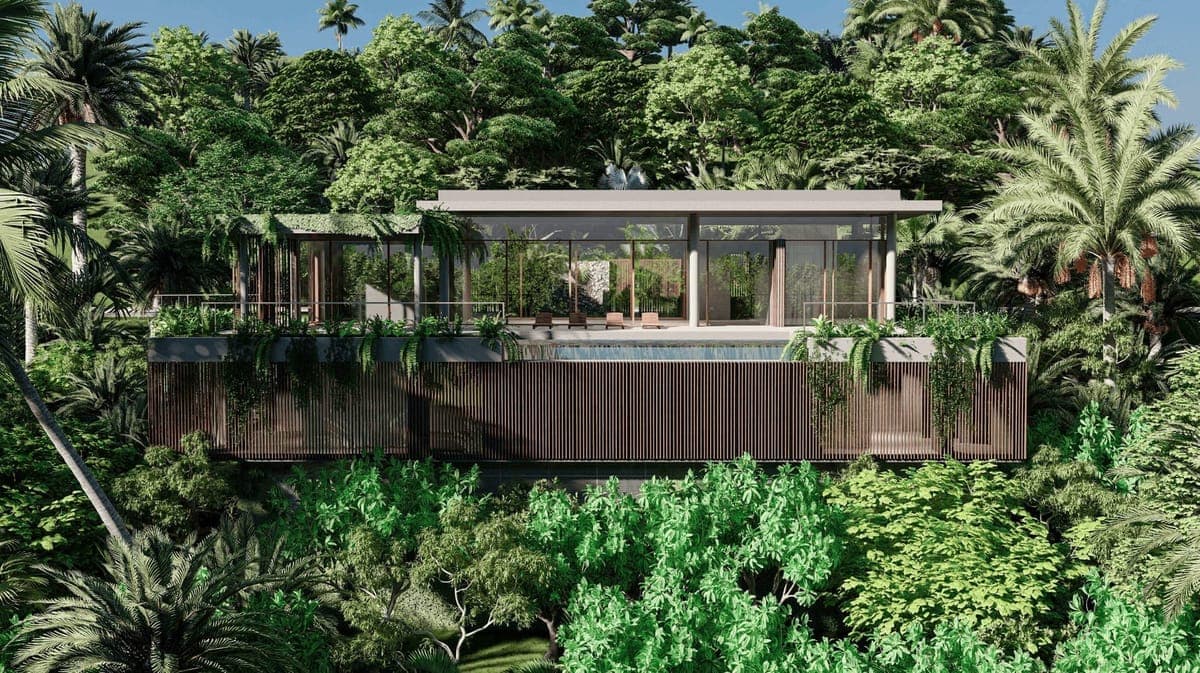
Why do earth-tone exterior colors matter for tropical house design? A look at how color choices affect heat, glare, ecology, and visual integration in the Samaná hills.
White exterior walls are not permitted in our building guidelines — and the reason is practical, not aesthetic dogma. In the Samaná hills, a bright white villa reflects harsh glare into neighboring lots, disrupts the way birds and insects read the landscape, and stands out as a scar on a green hillside. Earth-tone palettes solve all three problems at once. Here's the design logic behind the rule, and why it belongs in any serious conversation about sustainable architecture in the tropics.
What You Need to Know
- Our building guidelines ban white exterior walls; earth-tone palettes are required so villas visually recede into the hillside.
- Glare, wildlife disruption, and visual fragmentation are the three problems white walls create in a wooded tropical setting.
- Color is one layer of a wider tropical house design system — alongside flat roofs, column foundations, and the 40 cm solar height cap.
- The El Jamito site holds 153 documented plant species (per our environmental impact study), which is why blending in matters ecologically, not just visually.
- Earth tones are a low-cost, high-impact sustainability move — no premium technology required.
Why Ban White Walls in the First Place?
Because in a densely vegetated hillside like El Jamito, a white building fights the landscape instead of settling into it. White is the default color of Caribbean resort marketing, but it was never chosen for the tropics — it was chosen because it photographs well against blue water.
On a wooded slope 150 to 300 metres above the sea, the visual context is green and brown, not turquoise. A white box reads as an intrusion from every angle: from the road, from neighboring villas, from the beaches below. Earth tones — ochre, clay, olive, warm grey, muted terracotta — let a home sit inside the treeline rather than on top of it.
Our rule is simple: an exterior color should let the house disappear from the ridgeline, not announce it. If you can spot the villa from Playa Cosón before you spot the trees around it, we've built it wrong.
The takeaway: color is the cheapest way to make a building respect its site, and we treat it as non-negotiable.
How Do White Walls Create Heat and Glare Problems?
White surfaces reflect visible light aggressively, and in a hillside cluster that reflected light lands somewhere — usually a neighbor's terrace or bedroom window.
The glare problem between villas
At the elevation and spacing of the El Jamito lots, homes share sightlines. A white wall in full Samaná sun — with 240+ days of sunshine per year — becomes a mirror throwing hard light across the slope. Earth tones absorb more of that visible spectrum and scatter far less, so the villa next door keeps its shade and its views.
Color, heat, and the roof distinction
Here's the honest nuance: for roofs, light colors do reduce heat gain, which is why cool-roof strategies exist. But our exterior walls are shaded by deep overhangs, cross-ventilated interiors, and column construction that lifts the mass off hot ground. The wall color's thermal role is minor compared to its glare and ecological role. We optimize the roof for heat (flat, low-slope, green-roof-friendly) and the walls for integration. Passive cooling does the heavy lifting on comfort — passive cooling in tropical homes explains how that system works without relying on the AC.
The takeaway: on walls, glare and ecology outweigh the modest thermal argument for white.
What Do Earth Tones Do for Wildlife and Ecology?
They reduce the disruption a hard, bright surface causes to birds, insects, and the way animals navigate a wooded slope.
Bright artificial surfaces confuse wildlife. Reflective white walls contribute to the same disorientation as artificial light — birds misread reflections, and pollinators are drawn to or repelled by surfaces that don't belong in a natural palette. On a site where our environmental impact study documented 153 plant species, the building is a guest in a functioning ecosystem, and its skin should read as part of the background.
"Habitat fragmentation and the built environment's visual footprint are recognized pressures on biodiversity." — IUCN, on threats to species habitats
Muted, landscape-matched colors keep the hillside legible to the creatures that live there. For a fuller picture of what shares the slope, see our profile of the palmchat and the wild fauna of the Samaná hills. The Caribbean sits inside a recognized global biodiversity hotspot, which raises the stakes on every design decision — a point the region's conservation bodies and researchers have consistently emphasized.
The takeaway: earth tones are a stewardship choice as much as a style choice.
How Does Color Fit Into the Whole Design System?
Color is one rule among several that all push the same direction: build with the land, not against it.
A single color rule in isolation would be cosmetic. Ours sits inside a coordinated set of guidelines drawn from our project documents:
| Guideline | Requirement | Purpose |
|---|---|---|
| Exterior walls | No white; earth-tone palettes only | Visual integration, reduced glare |
| Roofs | Flat/low-slope; green roofs encouraged; aluminum banned | Heat management, blending, no glare from above |
| Solar panels | Roof-mounted, height-capped at 40 cm | Keeps arrays out of the sightline |
| Sloped lots | Villas built on columns | Preserves topography, roots, and drainage |
| Wastewater | Individual treatment system per villa | Protects soil and groundwater |
Every one of these choices answers the same question: how do you place a luxury home on a fragile hillside without degrading it? Color is the most visible answer, but the column foundations and roof rules matter just as much. For how these rules translate into finished homes, see eco villas designed to work with the land.
The takeaway: banning white walls only works because it's part of a system, not a standalone gesture.
Do Earth Tones Mean Sacrificing Design or Luxury?
No — a landscape-matched palette expands the design vocabulary rather than limiting it.
Some of the most admired tropical architecture in the world — from Geoffrey Bawa's Sri Lankan work onward — uses earth tones, natural stone, and timber precisely because they age gracefully in humid, high-UV conditions. White renders show every streak of mold, rain, and mineral staining within a season. Warm ochres and clays hide the honest wear of a tropical climate and need repainting far less often.
Consider a buyer weighing finishes: a Munich family drawn to clean, modern lines worries that "earth tone" means rustic or dated. In practice, a charcoal-and-timber facade with crisp geometry reads as contemporary and disappears into the treeline — the exact opposite of dated. Restraint, not decoration, is what modern tropical design is built on.
The takeaway: earth tones lower maintenance, age better, and still support a sharply modern look.
Frequently Asked Questions
Are white walls banned everywhere in the Dominican Republic?
No — this is a Sienna building guideline for the El Jamito development, not a national law. Many DR properties use white. Our rule reflects the specific ecology and hillside sightlines of the Samaná site.
What colors are actually allowed?
Earth-tone palettes that blend with the landscape — ochres, clays, olives, warm greys, and muted terracottas. The test is whether the finished home recedes into the green hillside rather than standing out against it.
Does wall color affect how hot the house gets?
Less than most people assume. Deep overhangs, cross-ventilation, and column construction manage heat far more than wall color does. The roof — flat, low-slope, and optimized for heat — carries the thermal load, while walls are optimized for glare and ecological blending.
Is following these design rules more expensive?
Earth-tone paint costs the same as white. The broader sustainable design system can add cost — column foundations and individual wastewater treatment aren't free — but color itself is a zero-premium sustainability win.
Bringing It Together
Banning white walls is a small rule with outsized effect: less glare between neighbors, a lighter footprint on a slope holding 153 plant species, and homes that read as part of the Samaná hills rather than objects dropped onto them. It's a clear example of what sustainable architecture looks like when it's practiced rather than advertised — specific, local, and backed by our own building guidelines.
Curious how the full design system shapes what gets built here? Explore our approach to [sustainable construction in the tropics]To see how these principles are built into Sienna, from solar and water to the food forest, visit Sustainable Living at Sienna.
Stay in the loop
Have questions about this?
Talk to our sales team directly — we'll answer on WhatsApp or by phone.
Written by
Sienna Terrenas Editorial Team
The Sienna Terrenas editorial team covers buying, owning, and living in Las Terrenas, Dominican Republic — from the purchase process and CONFOTUR tax strategy to villa construction and Caribbean community life, drawing on the team's on-the-ground experience in the area. Meet the Sienna Terrenas team.


