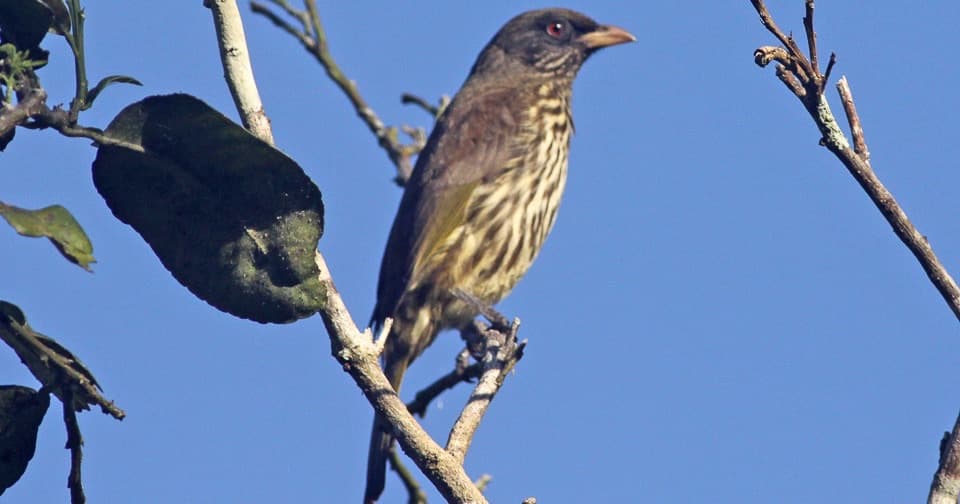
Meet the palmchat, the Dominican Republic's national bird and the sole member of its family — plus the reptiles, mammals, and birds that share the Samaná hills.
The Dominican Republic's national bird is the palmchat (Dulus dominicus) — a small, streak-breasted, sociable bird found nowhere on Earth except Hispaniola and a couple of nearby islands. It is the only living species in its entire family, Dulidae. The country has no single officially decreed national land animal, but the palmchat is the recognized national bird, and it's the animal you'll notice first in the hills above Las Terrenas: it builds bulky communal stick nests in the crowns of royal palms and chatters constantly.
The palmchat at a glance
| Fact | Detail |
|---|---|
| Scientific name | Dulus dominicus |
| Spanish name | Cigua palmera |
| Family | Dulidae — the only species in it |
| Where it lives | Hispaniola and a few nearby islands, nowhere else |
| Size | About 15–20 cm |
| Diet | Fruit and flowers |
| Nest | Large communal stick nests in royal palms |
| Status | Not endangered — common and adaptable |
What You Need to Know
- The palmchat (Dulus dominicus) is the Dominican Republic's national bird and the only member of its family, endemic to Hispaniola.
- The DR has no formally decreed national mammal; the palmchat is the standout national symbol, alongside endemic reptiles like the Hispaniolan anole.
- The Samaná hills host a distinctive fauna: hummingbirds, todies, geckos, hutías, and — offshore — Samaná Bay's humpback whales.
- Building on these slopes carries real habitat obligations — our environmental license (License 0644-26) attaches 57 binding obligations.
- Sienna's building guidelines require column foundations on slopes to preserve tree roots, and an on-site flora inventory (EsIA) documented 153 plant species.
Why Is the Palmchat the Dominican Republic's National Bird?
The palmchat earns its national-symbol status because it is genuinely one of a kind — a bird you cannot see anywhere outside Hispaniola. Taxonomists place it alone in the family Dulidae, meaning it has no close living relatives. That endemism is exactly what makes it a fitting emblem for a country that shares an island but keeps its own wildlife.
A bird that lives like a neighbor
Palmchats are relentlessly social. They build large, shared stick nests — sometimes a meter or more across — in the tops of royal palms, with several pairs using separate chambers in the same structure. You'll hear them before you see them: a rolling, gurgly chatter that carries across a hillside at dawn. Around 15–20 cm long, olive-brown above with heavy dark streaks on a pale belly, they feed on fruit and flowers rather than insects.
For anyone in El Jamito, the hills above Las Terrenas, the palmchat is the resident that never leaves. Where royal palms stand, the nests follow.
Does the Dominican Republic Have a National Animal?
Not in the strict, single-decree sense — the palmchat is the country's recognized national bird, and it functions as the de facto national animal. There is no separately proclaimed national mammal or reptile. That gap is partly a reflection of Hispaniola's biology: its most remarkable land animals are small, nocturnal, and easy to overlook.
The mammals you'd never see on a billboard
The island's two native land mammals are both survivors from a much older Caribbean fauna:
- The Hispaniolan hutía (Plagiodontia aedium), a stocky, tree-climbing rodent, largely nocturnal.
- The Hispaniolan solenodon (Solenodon paradoxus), an insectivore with a flexible snout and — unusually for a mammal — venomous saliva.
Both are threatened and rarely encountered. The IUCN Red List classifies the solenodon among the world's few surviving venomous mammals and flags it as a conservation priority. Neither is common in the Samaná hills today, which is precisely why habitat matters: fragment the forest and species with nowhere else to go simply disappear.
What Birds Live in the Samaná Hills?
Beyond the palmchat, the hills above Las Terrenas hold a dense cast of birds, several of them Hispaniolan endemics you won't find on the North American mainland.
Endemics worth learning to spot
- Broad-billed tody (Todus subulatus) — a tiny, round, emerald-green bird with a red throat, one of the island's best-loved endemics.
- Hispaniolan woodpecker (Melanerpes striatus) — noisy, colonial, and common in palm groves.
- Antillean mango and Hispaniolan emerald hummingbirds, drawn to flowering trees and gardens.
- Hispaniolan parakeet and parrot, both under pressure from habitat loss and trapping.
The Dominican Republic sits inside the Caribbean Islands biodiversity hotspot — one of the planet's most concentrated and most threatened reservoirs of endemic life, as documented in the Caribbean chapters of the region's conservation literature indexed on JSTOR's open-access ecology journals. High endemism means high stakes: a bird that lives only here has no backup population anywhere else.
What Reptiles and Other Wildlife Share These Slopes?
The Samaná hills are quietly full of reptiles and amphibians, most of them harmless and many of them endemic.
Lizards, geckos, and frogs
You'll routinely see Hispaniolan anoles (Anolis species) basking on walls and doing their throat-fan displays, plus small geckos that patrol ceilings at night eating mosquitoes — an unpaid pest-control service worth keeping around. Endemic Eleutherodactylus frogs (tiny "coquí"-type land frogs) call after rain. There are non-venomous Hispaniolan snakes as well, shy and rarely seen.
The wildlife just offshore
The Samaná story isn't only terrestrial. Each winter, thousands of North Atlantic humpback whales migrate to Samaná Bay to breed and calve — one of the Caribbean's signature wildlife spectacles, covered in most guides to the region including Lonely Planet's Dominican Republic coverage. For a fuller picture of the peninsula's wildlife, the beaches, whales and waterfalls, our Samaná Peninsula guide maps out what lives where.
Why Does Building Method Decide Whether This Fauna Survives?
Because the single biggest threat to Samaná's endemic fauna isn't hunting — it's habitat loss from clumsy development. Bulldoze a slope flat and you kill the root systems, the leaf litter, the nesting trees, and the drainage in one pass. How a developer builds on a hillside directly determines whether the anoles, todies, and palmchats stay.
What sustainable building on a slope actually requires
This is where our own project obligations get concrete. Our environmental license, License 0644-26, carries 57 binding environmental obligations — not marketing language, but conditions we're legally accountable for. From our building guidelines:
- Villas on sloped terrain build on columns, not cut-and-fill platforms, to preserve topography, tree root systems, and natural drainage.
- White exterior walls are banned in favor of earth-tone palettes that blend into the hillside rather than glaring out of it.
- Aluminum roofing is banned; flat and low-slope roofs are required, and green roofs are encouraged.
- Roof-mounted solar is height-capped at 40 cm so installations don't break the ridgeline.
The development spans 70 acres with a large share held as protected natural environment — space that stays as habitat. Our approach to building around the land rather than over it is the difference between a hillside that keeps its birds and one that doesn't. If sustainable construction methods interest you, our breakdown of what actually matters when you build in the tropics goes deeper on the specifics.
Curious where you'd fit into a community built around protecting this landscape? The simplest next step is to come and see it: the Discovery Tour is four nights in Las Terrenas with property visits and the legal and market sessions.
Frequently Asked Questions
What is the national bird of the Dominican Republic?
The national bird is the palmchat (Dulus dominicus), an endemic species found only on Hispaniola and a few nearby islands. It is the sole living member of its family, Dulidae, and is known for building large communal stick nests in royal palms.
Does the Dominican Republic have a national animal?
The DR has not formally decreed a single national land animal or mammal. The palmchat serves as the country's recognized national bird and de facto national animal. Its native land mammals — the Hispaniolan hutía and solenodon — are both threatened and rarely seen.
Is the palmchat endangered?
No. Unlike many Hispaniolan endemics, the palmchat remains relatively common and adaptable, thriving in palm groves, gardens, and lightly developed areas. Its long-term security still depends on royal palms and open woodland being preserved.
What wildlife can I see in the Samaná hills?
Palmchats, broad-billed todies, Hispaniolan woodpeckers, hummingbirds, anoles, geckos, and endemic land frogs are all common in the hills above Las Terrenas. Offshore, Samaná Bay hosts migrating humpback whales each winter.
How does building on a hillside affect local wildlife?
Cut-and-fill construction destroys root systems, nesting trees, and drainage, fragmenting habitat. Building on columns, keeping green space, and using earth-tone, low-profile design — as required under our License 0644-26 obligations — lets fauna keep living on the slope.
The Takeaway
The palmchat tells you something about this whole island: much of its most valuable wildlife exists nowhere else, which means what's lost here is lost everywhere. The Samaná hills still hold that endemic richness — todies, hutías, anoles, and the chattering palmchat colonies overhead — but only where the land is built on carefully rather than scraped flat.
If you want to understand the fuller ecosystem behind these hills, read our Samaná Peninsula guide, and to see how a national symbol like the endangered Bayahibe rose fits the same conservation story, that companion piece is a good next stop.
Cover photo: Palmchat (Dulus dominicus) by Ron Knight, licensed CC BY 2.0, cropped.
Stay in the loop
Have questions about this?
Talk to our sales team directly — we'll answer on WhatsApp or by phone.
Written by
Sienna Terrenas Editorial Team
The Sienna Terrenas editorial team covers buying, owning, and living in Las Terrenas, Dominican Republic — from the purchase process and CONFOTUR tax strategy to villa construction and Caribbean community life, drawing on the team's on-the-ground experience in the area. Meet the Sienna Terrenas team.


