A buyer’s guide to Las Terrenas.
What Las Terrenas is, how it became the most cosmopolitan town on the Samaná Peninsula, and what to understand before you buy property here.
Las Terrenas is the town on the north side of the Samaná Peninsula that thirty years of French, Italian and Swiss expats turned from a fishing village into the most cosmopolitan small town in the Dominican Republic. The beaches are the reason most people first arrive. The food, the pace and the property values are usually why they stay.
This page covers the basics of Las Terrenas as a destination and as a real-estate market — written for someone seriously considering buying here.
How a fishing village became a destination.
Until the 1980s, Las Terrenas was a small fishing settlement reachable only by a rough mountain track from the south. The first Europeans — mostly French, drawn by the beaches and the cheap land — arrived in that decade and started a slow build-out of small hotels and restaurants.
The Boulevard Turístico del Atlántico opened in 2011 and the AZS airport at El Catey followed shortly after, both of which fundamentally changed the access story. What had been a five-hour drive from Santo Domingo became two; what had been almost impossible to reach internationally became a direct flight.
The town has grown since, but it has grown without losing the original character. The Pueblo de Pescadores — the old fishermen’s village — is still the heart of the dining scene. Calle Principal still feels like a town centre.
The four beaches that define the town.
Each is a different experience, and each is within fifteen minutes of the centre.
Playa Bonita
Wide, calm and shaded with palms. The town beach for the western end of Las Terrenas, and the easiest beach for families.
Playa Cosón
Six kilometres of open Atlantic beach to the west. Surfable on the right swell, walkable in either direction, mostly empty by mid-afternoon.
Playa Las Ballenas
The central town beach — named for the two whale-shaped rocks just offshore. Sunset crowd, bars on the sand.
Playa Las Terrenas
Long, flat and protected by an offshore reef. Easy swimming, plenty of restaurants on the boardwalk side.
What everyday life looks like.
Three things people consistently mention after a first visit.
A French-Caribbean food scene
Three decades of French, Italian and Swiss expat settlement gave Las Terrenas a restaurant culture that is genuinely uncommon in the Caribbean. Fresh fish at the Pueblo de Pescadores, croissants at any of the bakeries on Calle Principal, real wine lists.
A town that runs in three languages
Spanish, French and English are all functional. Many residents and shop owners speak two of the three; signage frequently runs in all three. The town is easy to settle into without fluent Spanish.
Year-round outdoor weather
Average highs sit in the high 20s to low 30s°C all year. The rainy season is short bursts, mostly in May and October. The trade winds from the Atlantic keep the heat manageable.
The Las Terrenas real-estate market, in plain terms.
Four things to understand before you start looking at listings.
Hillside ocean-view land is the scarce category
The flat town and beach plots filled up first; the hillside above town is where most of the new high-quality development is happening, and the supply of true ocean-view lots is finite because of the topography.
CONFOTUR is the defining tax fact
Qualifying projects waive transfer tax, annual property tax, and income tax on rentals for 15 years. This materially changes the cost of ownership and the real yield on rentals.
Foreign ownership is unrestricted
There is no restriction on foreign ownership of Dominican real estate. Buyers hold title in their own name or through a Dominican company, depending on the structure that suits their tax situation.
The rental market is real, not theoretical
Short-term vacation rental demand is well established in Las Terrenas, driven by European seasonal visitors and a growing North American market. Yields vary with location, finish quality and management.
Getting to Las Terrenas.
Three airports, three trade-offs.
On the peninsula itself. Seasonal direct flights from Montreal, Toronto, Paris, Brussels, Frankfurt and others.
The largest Dominican airport, with year-round flights from the US, Canada and Europe. The Boulevard Turístico del Atlántico goes straight to the peninsula.
Useful if you want to combine Las Terrenas with the north coast — Cabarete, Sosúa or Puerto Plata itself.
Where Sienna sits in Las Terrenas.
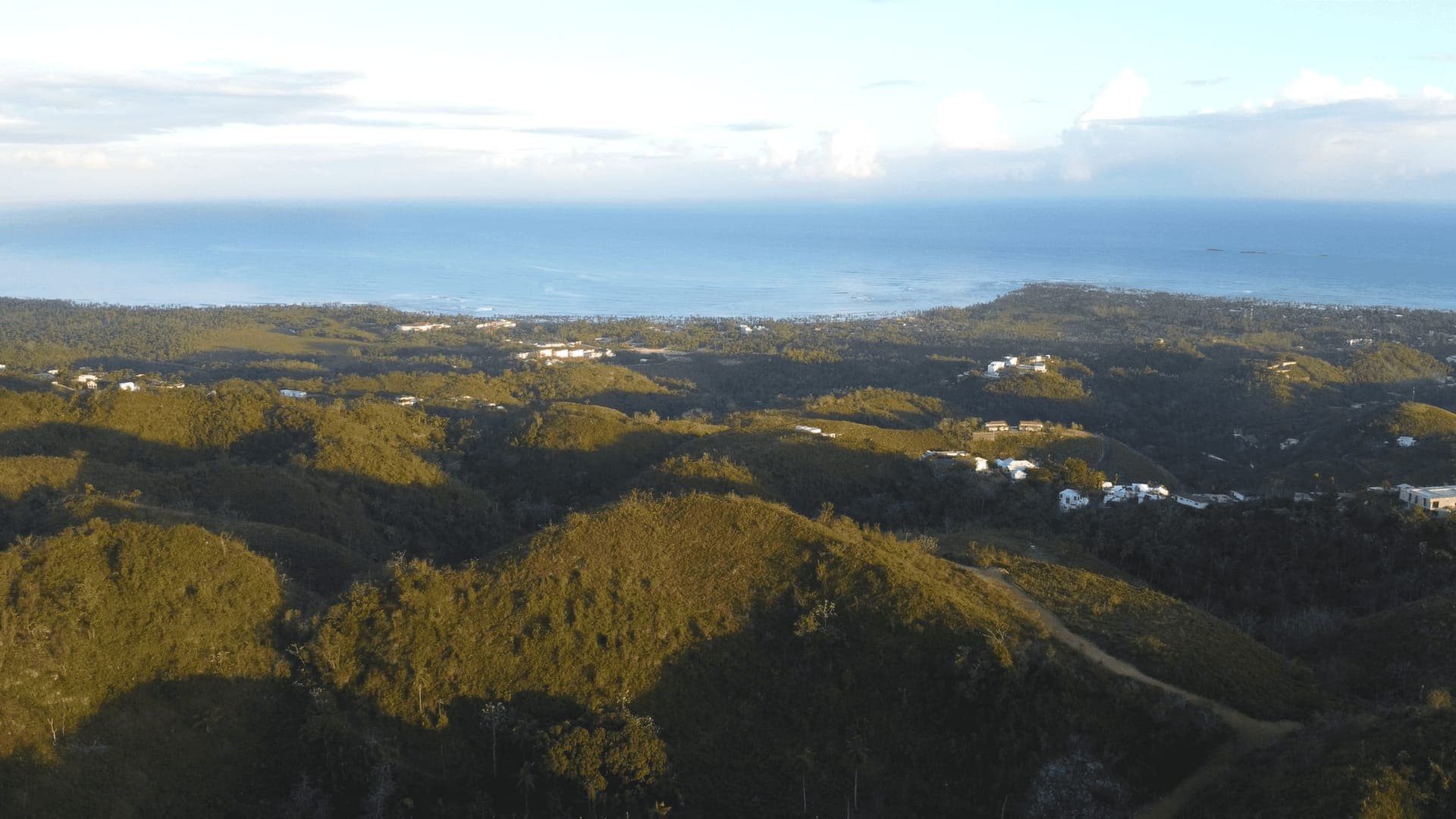
Sienna is on the hillside above Las Terrenas — seventy acres of oceanview land with the town centre, the supermarket and the Pueblo de Pescadores restaurants seven minutes down the hill. The lots look out over the Atlantic and across to Playa Cosón.
The project holds provisional CONFOTUR classification (Resolution 203-2024) and is designed as a long-term community rather than a resort — full and fractional ownership, a managed rental program, and an HOA framework built to protect the character of the hillside.
Going deeper.
The longer-form articles that pair with this guide.
Doing more than reading?
The team behind Sienna lives here. If you want a real conversation about the town, the market and what would actually fit you, the easiest way is to book a call.