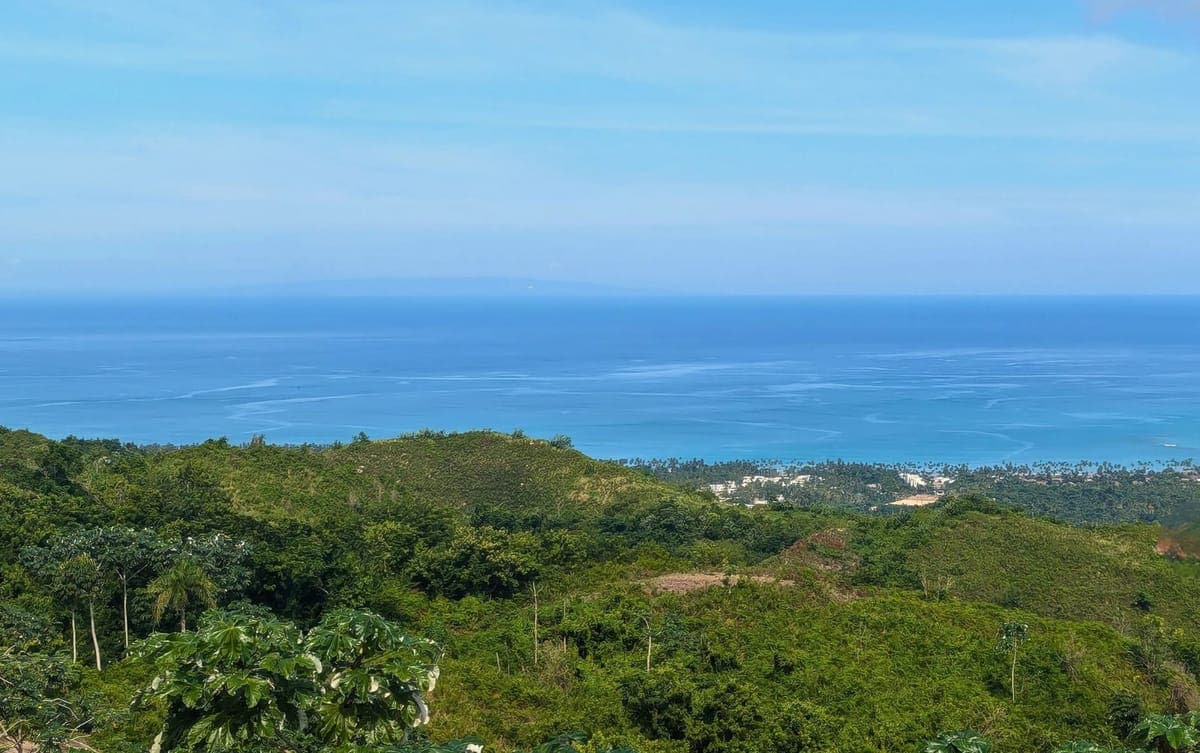
Samaná Peninsula: the most beautiful corner of the Dominican Republic.
A 50-kilometre peninsula on the country’s northeast coast, ringed by some of the Caribbean’s best beaches and visited each winter by the Atlantic humpback whales.
The Samaná Peninsula is the long green finger of land that points east from the Dominican Republic’s north coast. It is, by most accounts, the country at its most striking — mountains that rise straight from the sea, beaches that have stayed empty because the peninsula is genuinely off the main tourist routes, and a culture that is closer to the Caribbean of fifty years ago than to the resort zones to the south.
For anyone considering property in the Dominican Republic, Samaná is the part of the country worth understanding first. This page is the orientation; the next layer of detail lives on our dedicated Las Terrenas guide.
The peninsula’s three towns.
Samaná is not one destination but three, each with its own character. People who know the area tend to pick one and stay loyal.
Las Terrenas
The peninsula’s most cosmopolitan town — a fishing village reshaped by decades of French, Italian and Swiss expats. Long beaches, walkable centre, the most developed dining scene in Samaná.
Las Terrenas town guideSanta Bárbara de Samaná
The peninsula’s capital and the seat of provincial government. Working port, the gateway to Cayo Levantado and the whale-watching boats that leave from the malecón January through March.
Las Galeras
The quiet eastern tip. Smaller, slower, and home to Playa Rincón — routinely listed among the best beaches in the Caribbean. Less infrastructure, more solitude.
The beaches that make the case.
Samaná’s coastline is the reason most people come, and the reason most people come back. A short list, not an exhaustive one.
Playa Rincón
Las Galeras side
Three-kilometre crescent backed by coconut palms; reachable by boat or rough track.
Playa Bonita
Las Terrenas side
Wide and flat, with the calmest swimming of the Las Terrenas beaches.
Playa Cosón
Las Terrenas side
Six kilometres of open Atlantic beach — surfable, walkable, mostly empty.
Cayo Levantado
Samaná bay
The “Bacardi Island” — a 25-minute boat from the port at Santa Bárbara.
Playa Frontón
Las Galeras side
A cliffside cove only reachable by boat or a one-hour hike. Snorkelling is exceptional.
Playa Las Ballenas
Las Terrenas town
The town beach — named for two whale-shaped rocks offshore. Sunset bars line the sand.
The humpback whales return every January.
From mid-January through mid-March, roughly two thousand North Atlantic humpback whales gather in Samaná Bay to mate and calve. It is one of the largest concentrations of humpbacks anywhere in the world, and it is genuinely close to shore.
Permitted whale-watching boats leave from the port at Santa Bárbara de Samaná. The best operators carry a marine biologist and follow strict approach distances; the whole season is regulated by the Ministry of Environment.
If you are scouting property and your dates are flexible, February is the month to come.
Why Samaná is not Punta Cana.
Both are on the coast. Both have beaches and palms and sun. That is where the similarity ends.
Geography, not branding
Samaná is a peninsula, not a resort zone. The Cordillera Samaná drops directly into the Atlantic, which produces the cliffs, coves and steep green hills that define the look of the area — nothing like the flat coastline of the south or east.
A different kind of tourism
There is no airport corridor of all-inclusives here. Visitors are mostly European, mostly independent, and mostly drawn by the beaches and the whales. The town centres still feel like towns.
Protected by access
The toll road from Santo Domingo and the AZS airport opened the peninsula in 2011, but it remains a deliberate detour for most travellers. That friction is why Samaná has kept its character.
Getting to the peninsula.
Three viable airports, three different trade-offs. Most international buyers arrive through one of these.
AZS — Samaná El Catey International
On the peninsula itself, 40 minutes from Las Terrenas. Direct seasonal flights from Montreal, Toronto, Paris, Brussels and Frankfurt.
SDQ — Santo Domingo Las Américas
The largest international gateway, with year-round flights from the US, Canada and Europe. The Boulevard Turístico del Atlántico toll road reaches the peninsula in about two hours.
POP — Puerto Plata
Three hours by car along the north coast. Useful when you want to combine Samaná with Cabarete or Sosúa on the same trip.
Going deeper.
Longer-form articles for buyers building a thesis on the peninsula.
Where Sienna sits on the peninsula.
Sienna is on the hillside above Las Terrenas — the largest and most developed of the three peninsula towns, and the one with the easiest year-round access. From the lots, you look out over the Atlantic and across to Playa Cosón; the town centre, the supermarket and the Pueblo de Pescadores restaurants are seven minutes down the hill.
The peninsula matters because the location does the heavy lifting on resale. Hillside ocean-view land in this part of Samaná is finite, and the topography of the Cordillera limits how much more can be built.