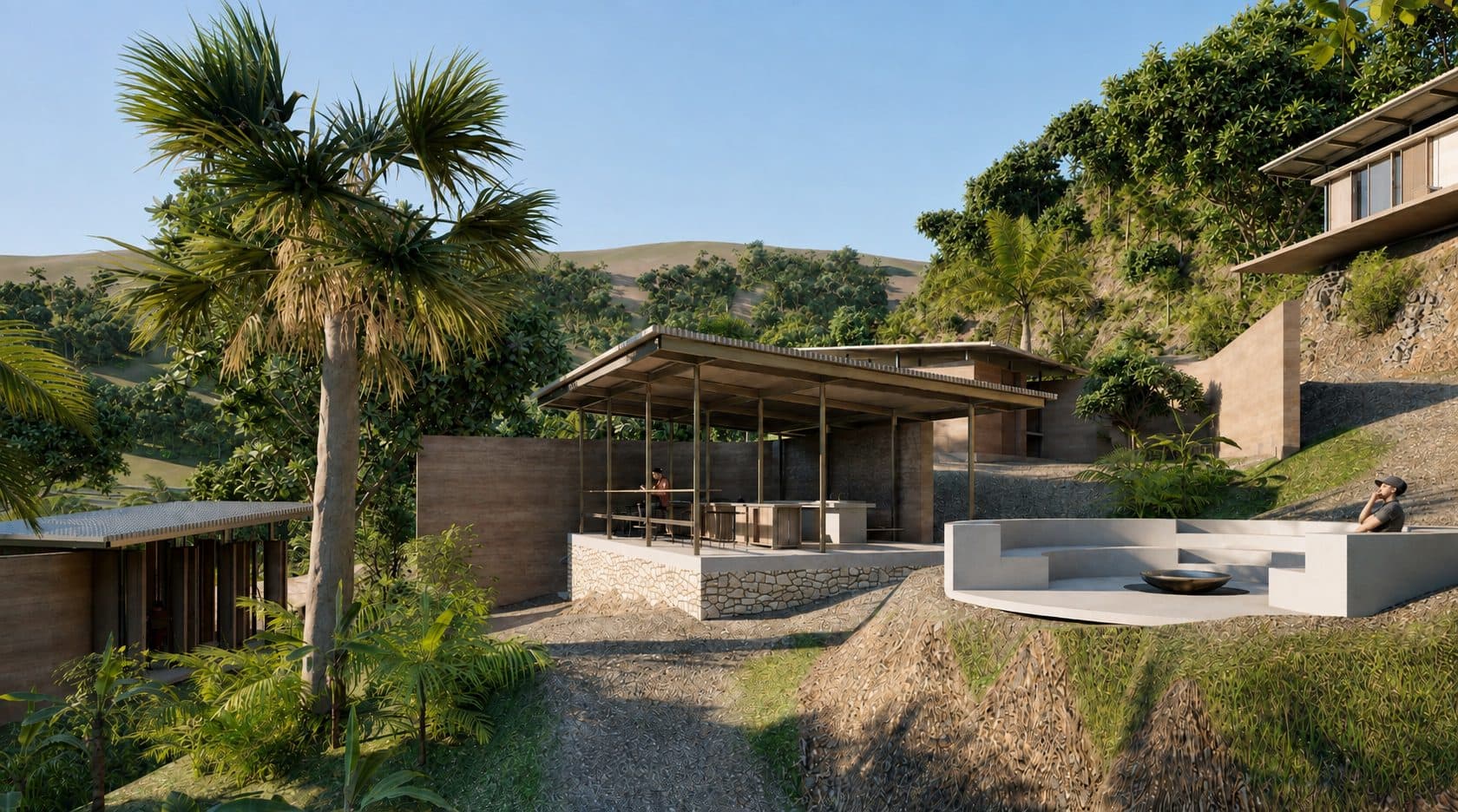
A practical look at how Sienna manages organic and recyclable waste in shared areas — community composting feeding the collaborative farm, source separation, and diversion away from landfill.
The title says Zone 2, but Sienna's shared-area waste system applies to the development as a whole, and here is the short answer: organic waste from Sienna's common areas is composted on-site and fed back into the collaborative farm, recyclables are sorted at source into separate streams, and what remains goes to municipal collection. The goal is to keep food scraps and green waste out of the landfill and turn them into soil. This is community composting built into how the development runs, not a line in a brochure.
The Short Version
- Common-area organic waste is composted on-site and used on the collaborative farm and in landscaping.
- Recyclables are sorted at source — glass, plastics, metal, paper — rather than mixed and hoped-over.
- The system is distinct from each villa's own septic and grey-water setup, which operates per home.
- Diversion keeps compostable and recyclable material out of the municipal waste stream heading to landfill.
- This is a shared-amenity operation under the HOA, not something each owner manages alone.
What Counts as Common-Area Waste at Sienna?
Common-area waste is everything generated outside the four walls of a private villa: the collaborative farm, the landscaped grounds, shared gathering spaces, and the organic gardens. It is green waste, food scraps from shared kitchens and events, and the recyclables that collect wherever people gather.
This matters because it is the waste stream Sienna can actually control as an operator. Your villa's kitchen bin is yours. But the clippings from 70 acres of landscaping, the prunings from native-plant beds, and the organic material from the farm — that is a steady, predictable flow of material. Handled well, it becomes a resource. Handled badly, it becomes trucks heading to a landfill.
Las Terrenas, like much of the Samaná peninsula, has limited municipal recycling infrastructure. If a development does not sort and divert on its own, almost everything ends up mixed. That is the gap on-site systems are designed to close. For the fuller picture of how shared amenities fit together, see our complete guide to Sienna amenities.
How Does Community Composting Work at Sienna?
Organic material is collected, broken down on-site, and returned to the land as compost — closing the loop between what the grounds produce and what the farm needs.
From green waste to garden soil
Tropical sites produce a lot of green matter. Landscaping with 70% native plants means regular pruning and clearing, and all of that biomass is organic. Rather than bagging it for collection, Sienna's approach is to compost it. Add the food scraps from shared kitchens and community events, and you have the two ingredients a good compost pile needs: nitrogen-rich "greens" (food, fresh clippings) and carbon-rich "browns" (dry leaves, woody prunings).
The finished compost feeds the collaborative farm and the organic community gardens — the same gardens that supply farm-to-table produce for residents. If you want the detail on how that farm shares its harvest, our piece on Sienna's collaborative farm amenity covers it.
Why composting suits a Samaná hillside
Heat and humidity speed decomposition, so a tropical climate is well suited to composting — organic material breaks down faster here than in a temperate backyard pile. The warm, wet conditions that make the Samaná hills green are the same conditions that turn yesterday's clippings into usable soil amendment in a matter of weeks rather than months.
Composting is not waste disposal with a green label on it. It is the most local supply chain a farm can have: the grounds feed the pile, the pile feeds the soil, the soil feeds the table.
How Is Recycling Sorted in the Shared Areas?
Recyclables are separated at the point they are discarded — into glass, plastic, metal, and paper streams — because source separation is the only reliable way to recycle where single-stream collection does not exist.
Source separation beats sorting later
There is a reason serious recycling programs sort at source. Once food waste contaminates a mixed bin, paper and cardboard are often ruined, and the whole load risks being downgraded to landfill. Separating at the bin — clearly labelled stations in shared areas — keeps each material clean enough to actually be recycled or passed to a buyer who handles that stream.
Glass, in particular, is worth keeping separate: it is heavy, it does not degrade, and it is widely accepted by recyclers in the DR. Metals have scrap value. Clean cardboard has a market. The discipline is in the sorting, and that discipline is built into how the common areas are set up rather than left to chance.
What happens to each stream
| Waste stream | Handling | Destination |
|---|---|---|
| Food scraps & green waste | On-site composting | Collaborative farm & gardens |
| Glass | Source-separated | Recycler / reuse |
| Plastics | Source-separated, rinsed | Recycler |
| Metal | Source-separated | Scrap recovery |
| Paper & cardboard | Kept dry, separated | Recycler |
| Residual / non-divertible | Minimised | Municipal collection |
Why Does Waste Diversion Matter for an Eco Community?
Diversion — the share of waste kept out of landfill — is one of the clearest, most measurable signals that a development's sustainability claims are real. Composting and recycling are the two biggest levers any community has to raise that number.
Globally, roughly a third of all food produced is wasted, and the UN's environmental agency has repeatedly flagged food waste as a major and avoidable source of methane from landfills. Composting cuts that at the source: organic material that decomposes in an aerobic compost pile does not generate the same methane it would buried in a landfill. For a development marketing itself on sustainability, closing the organic loop is not optional — it is the proof.
This is also where buyers should apply scrutiny. Plenty of projects use green language without green operations. Our guide on how to vet an eco-developer's green claims walks through the questions worth asking — and a visible composting-and-sorting system is exactly the kind of answerable, verifiable practice that separates substance from marketing.
Where this sits alongside other eco-systems
Common-area waste is one piece of a larger picture that includes how Sienna powers its common areas with solar and water systems and how each villa handles its own wastewater. The waste-and-recycling program is deliberately kept distinct from villa-level septic: your home's sewage is treated at the home; the shared organic and recyclable streams are managed as a community amenity under the HOA.
Who Manages the System — the HOA or the Owner?
The shared-area waste and recycling system is run as a community amenity through the HOA, not something each owner has to organise. You benefit from it without operating it.
This is the practical upside of a managed development. A single owner sorting their own recyclables in a region with thin municipal infrastructure quickly hits a wall — where does it actually go? A community-scale program has the volume to make separation worthwhile and the structure to keep it consistent. Monthly HOA fees fund the shared operations that make this possible, alongside landscaping, security, and common-area upkeep. You can see how those fees and governance work in our overview of Sienna's HOA and community governance.
What you do at villa level is simple: separate your organics and recyclables at home, and the shared system takes it from there. What the community does is the harder part — maintaining the compost, keeping the streams clean, and ensuring material is diverted rather than dumped.
Frequently Asked Questions
Does the composting create smells or pests near the villas?
A properly managed compost operation — turned, balanced between greens and browns, and kept aerobic — does not smell like rot or draw pests. The composting area is sited as part of the farm and grounds operation, not next to living spaces, and the heat of the tropics actually accelerates clean decomposition.
Can I compost my own villa food scraps?
Yes. Owners are encouraged to separate organic waste at home, and the community system is designed to handle it. Many eco-minded owners also keep a small kitchen-garden compost of their own — our guide to starting an organic kitchen garden in the DR covers how.
Is recycling actually possible in Las Terrenas?
Reliably, only through source separation. Municipal single-stream recycling is limited across the Samaná peninsula, which is precisely why a development-run program that sorts glass, metal, plastic, and paper at the bin is the practical answer rather than relying on municipal collection to do it.
How is this different from the villa septic system?
Entirely separate. Each villa treats its own wastewater on-site; the waste-and-recycling program handles solid organic and recyclable material from shared areas. One is per-home infrastructure, the other is a community amenity.
Does good waste management affect resale value?
Verifiable sustainability operations are increasingly what eco-conscious buyers look for. A development that can show real diversion practices, not just marketing, holds credibility with the buyers most likely to pay a premium for genuine eco-living.
The Bottom Line
Sienna's common-area waste system composts organic material back into the collaborative farm and sorts recyclables at source, keeping compostable and recyclable material out of the landfill. It runs as an HOA-managed amenity, distinct from each villa's own septic, so you get the benefit without the burden. Want to see how the operations stack up against your own standards? Book a no-pressure consultation and ask us anything about how the development actually runs.
Stay in the loop
Have questions about this?
Talk to our sales team directly — we'll answer on WhatsApp or by phone.
Written by
Sienna Terrenas Editorial Team
The Sienna Terrenas editorial team covers buying, owning, and living in Las Terrenas, Dominican Republic — from the purchase process and CONFOTUR tax strategy to villa construction and Caribbean community life, drawing on the team's on-the-ground experience in the area. Meet the Sienna Terrenas team.