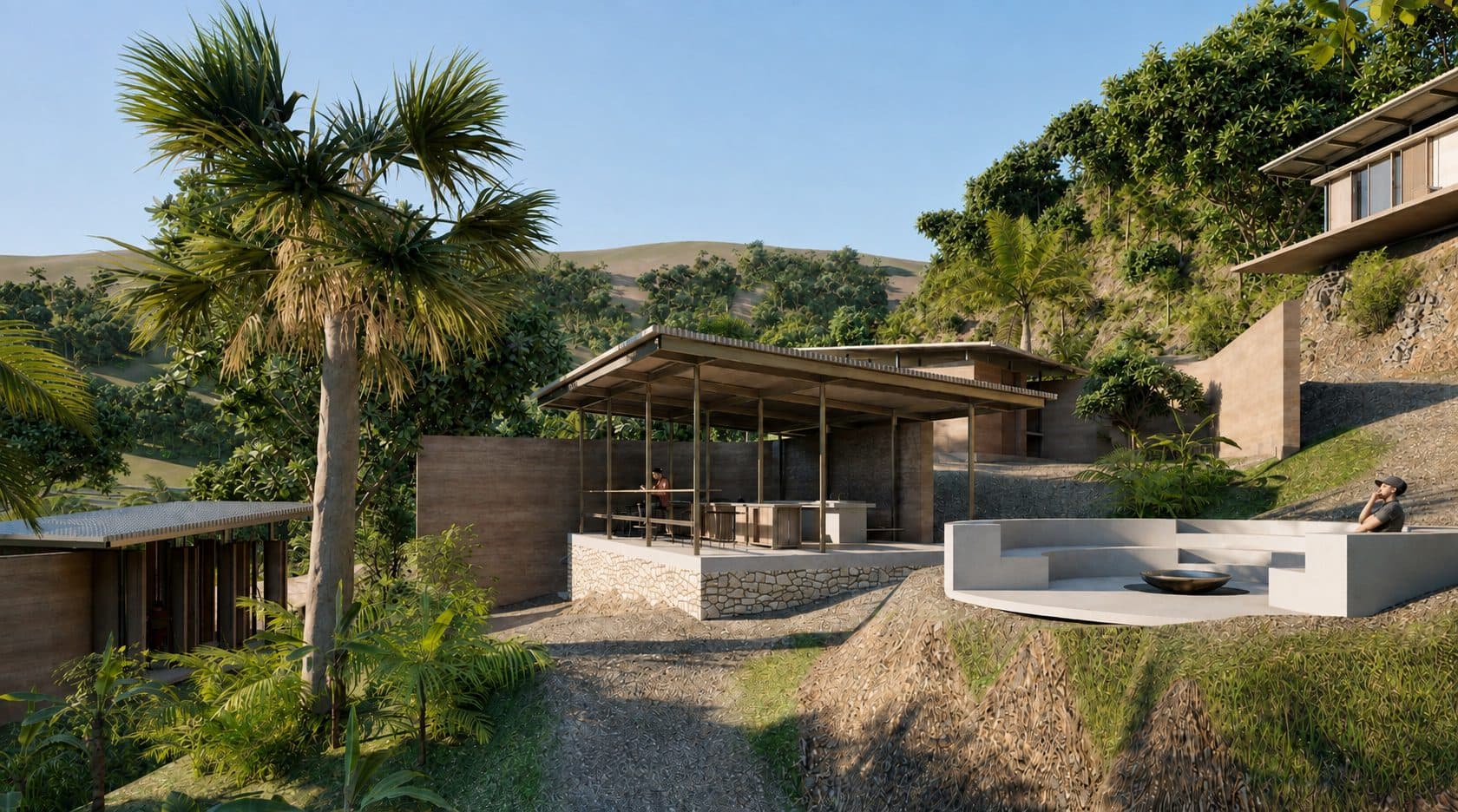
A look at how Sienna's common areas run on solar and rainwater — and how per-villa systems differ from the planned centralized shared infrastructure in an eco community.
The honest answer: at Sienna, sustainability is not one big power plant but two overlapping layers. Each villa carries its own solar, cistern, and wastewater treatment, while the shared amenities — the roads, the collaborative farm, the community water and lighting — are designed to run on centralized systems that mirror the same off-grid logic at a larger scale. That split is deliberate, and it's what lets the community deliver on its green claims without depending on a single point of failure.
The Short Version
- Every Sienna villa has its own solar-ready roof, rainwater cistern, and individual wastewater treatment — no villa relies on the grid for the essentials.
- Common areas (roads, farm, lighting, shared water) are designed around centralized solar, rainwater harvesting, and native landscaping in the 70-acre development.
- Sienna sits in the El Jamito hills at 150-300m elevation, which shapes how water is stored and gravity-fed downhill.
- 70% of landscaping is native plants, cutting irrigation demand for common green space.
- This is a consideration-stage guide — it explains the design logic, not live build progress, which Sienna's founder publishes by hand.
Why Split Systems at All? Per-Villa vs Centralized Infrastructure
The short answer: redundancy and independence. A community that pools everything into one shared system has one thing to break; a community where each villa is self-sufficient can lose a shared line and still keep the lights on inside every home.
Sienna's design treats the individual villa and the shared community as two tiers. At the villa level, each home gets solar-ready infrastructure, its own rainwater cistern, and its own individual wastewater treatment unit. Nothing about a single owner's daily comfort depends on a neighbor's system or a centralized plant.
At the community level, the shared amenities that no single villa owns — the entrance road lighting, the collaborative farm's irrigation, common landscaping — are planned around their own centralized sustainability systems. This is the layer most buyers mean when they ask how the community runs its green talk.
An eco-community earns trust the way an off-grid house does: by working when the grid doesn't. Independence at the villa, resilience at the shared scale.
If you want the full picture of what the shared spaces include, our complete guide to Sienna's amenities maps every common area across the development.
How Are Sienna's Common Areas Powered by Solar?
Sienna's shared amenities are designed to run on solar generation sized to community loads, not household ones. Common-area power — pathway and road lighting, farm equipment, shared pumps — draws from dedicated solar arrays rather than each villa subsidizing the neighborhood off its own roof.
Why solar makes sense here
Las Terrenas gets abundant year-round sun, and the El Jamito hillside sits at elevation with open exposure. That combination makes solar the obvious primary source for both villas and common areas. For a sense of how the numbers work at the household scale, our guide to sizing a solar system for a DR villa walks through panels and battery capacity.
Solar deployment across the Caribbean has accelerated as battery costs fall. The International Renewable Energy Agency's renewable capacity data shows solar leading new global additions, which is why designing common areas around it — rather than around a diesel generator or an unreliable grid tie — is the durable choice for a 70-acre community.
The elevation advantage
Building on a slope at 150-300m does two useful things at once: it gives common-area solar clean exposure, and it lets water move downhill by gravity, cutting the pumping load that solar would otherwise have to cover.
How Does Sienna Handle Water in Its Shared Spaces?
Shared water at Sienna is built on rainwater harvesting and gravity feed, the same principle applied to each villa's cistern but scaled to serve common areas and the farm.
Rainwater harvesting, community-scale
The Samaná Peninsula receives generous rainfall, and capturing it on-site is far more sustainable than trucking or over-pumping groundwater. Each villa has its own cistern (see our breakdown of cistern design for hillside homes), while common areas are designed around their own collection and storage. Our overview of rainwater harvesting in the Dominican Republic covers cistern sizing and real costs.
Native landscaping cuts the demand
Here's a detail that quietly matters: 70% of Sienna's landscaping uses native plants. Native species are adapted to the local dry and wet seasons, so common green space needs a fraction of the irrigation a lawn of imported grass would. Less irrigation means smaller pumps, smaller solar loads, and smaller cisterns — sustainability compounding on itself.
| System | Per-villa (individual) | Common areas (centralized) |
|---|---|---|
| Power | Solar-ready roof + battery | Dedicated community solar arrays |
| Water | Private rainwater cistern | Shared rainwater harvesting + storage |
| Wastewater | Individual treatment unit per villa | Managed within community standards |
| Irrigation | Owner's garden | Native landscaping (70%), gravity-fed |
| Internet | Satellite (Starlink) or local wireless | Not centralized; per-property |
Note the internet row: there is no fibre to the lots in the El Jamito hills. Connectivity is by satellite or a local wireless provider. Fibre exists in Las Terrenas town, but not up on the hillside — a distinction worth getting right if remote work is on your list.
What About Wastewater and the Farm?
Each villa treats its own wastewater on-site, and the collaborative farm is designed to close the loop between water, soil, and food.
Wastewater stays decentralized
Rather than piping everything to one central plant, each home runs an individual treatment unit. That's the resilient choice on a hillside — no long gravity sewer runs, no single failure point. It also keeps treated output close to where it can support landscaping.
The farm is part of the infrastructure
Sienna's collaborative farm amenity isn't decoration — it's a working part of the community's sustainability system, drawing on harvested rainwater and native-adapted planting. For the thinking behind edible landscapes on this terrain, see our piece on designing a food forest on a Samaná hillside. Sustainable tourism and community projects across the region increasingly use this integrated model; the Caribbean's shift toward it is covered in outlets like Caribbean Journal's sustainability reporting.
Is This Just Green Marketing, or Is It Real?
Fair question — plenty of developments talk green and deliver a token solar panel at the gate. The difference at Sienna is that sustainability is built into the physical infrastructure at both tiers, not bolted on.
The verifiable signals: individual wastewater treatment per villa, solar-ready roofs as standard, 70% native landscaping across 70 acres, and rainwater harvesting rather than groundwater dependence. These are design commitments you can check against the villa specs and the site plan, not slogans. If you want a framework for pressure-testing any developer's claims, we wrote a full guide on how to vet an eco-developer's green claims.
One caution on how we describe build status: this article explains the design of Sienna's systems. Live construction progress — what's installed on the ground today — is published directly by Sienna's founder, because only the site team knows the real state of the build at any moment.
Frequently Asked Questions
Does every Sienna villa run entirely off-grid?
Each villa has solar-ready infrastructure, its own rainwater cistern, and individual wastewater treatment, so the essentials don't depend on the grid. How fully off-grid a given home runs depends on the owner's battery and panel choices — our off-grid living in the DR guide covers what's realistic.
Is there fibre internet at Sienna?
No. There is no fibre to the lots in the El Jamito hills. Connectivity is via satellite (Starlink) or a local wireless provider. Fibre is available in Las Terrenas town but not on the hillside.
How does water reach villas on a hillside?
The 150-300m elevation lets rainwater stored in cisterns move downhill by gravity, reducing pumping and the solar load needed to power it. Our internet and connectivity guide and cistern articles cover the practical side.
Why use native plants for common landscaping?
Native species are adapted to Las Terrenas's wet and dry seasons, so common green space needs far less irrigation. That's roughly 70% of Sienna's landscaping, which shrinks water, pump, and solar demand across shared areas.
The Bottom Line
Sienna splits its sustainability into two tiers — self-sufficient villas and centralized common-area systems — so independence and resilience reinforce each other. Solar, rainwater harvesting, gravity feed, and native landscaping do the work at both scales. If you want to see how these systems translate into ownership costs and returns, explore our ROI tools and investment projections or book a no-pressure consultation to walk through the specifics.
Stay in the loop
Have questions about this?
Talk to our sales team directly — we'll answer on WhatsApp or by phone.
Written by
Sienna Terrenas Editorial Team
The Sienna Terrenas editorial team covers buying, owning, and living in Las Terrenas, Dominican Republic — from the purchase process and CONFOTUR tax strategy to villa construction and Caribbean community life, drawing on the team's on-the-ground experience in the area. Meet the Sienna Terrenas team.


