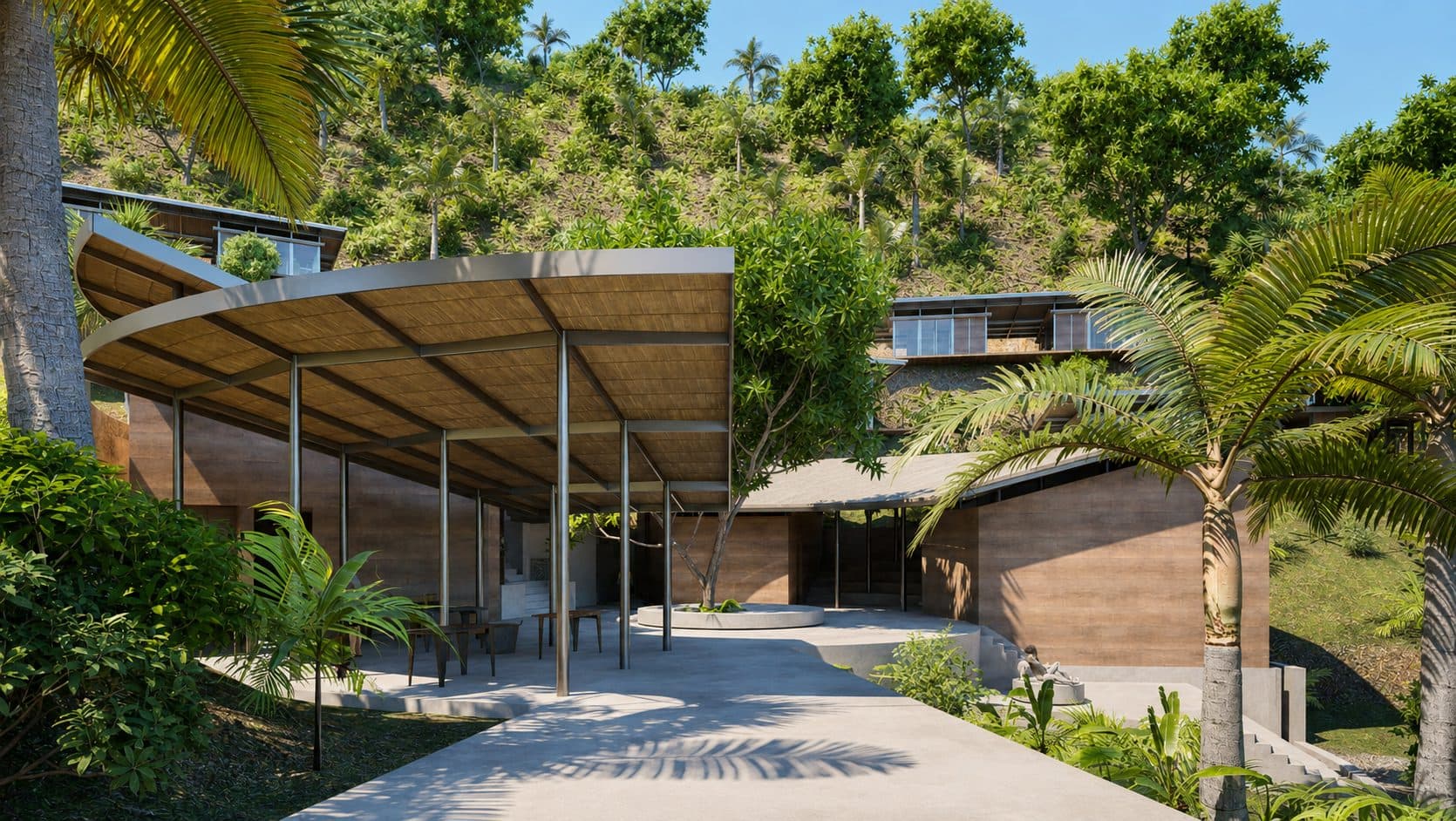
La construction durable sous les tropiques est un défi différent de celui des climats tempérés. Sept pratiques précises — conception passive, matériaux locaux, gestion de l'eau, détails anti-tempête et plus — qui déterminent si une villa des Caraïbes est réellement durable ou seulement présentée comme telle.
La construction durable sous les tropiques n'est pas le même défi que la construction durable en Suisse ou à Vancouver. Le climat est chaud, humide et exposé aux tempêtes ; la chaîne d'approvisionnement est contrainte ; les normes évoluent. La bonne réponse est un ensemble de pratiques précises — conception passive, choix des bons matériaux, détails de durabilité — et non un label ou une certification.
Ce guide passe en revue sept pratiques qui déterminent réellement si une villa des Caraïbes est durable dans un sens significatif, en s'appuyant sur les normes de construction employées à Sienna Terrenas et sur le cadre plus large de l'éco-développement dominicain.
Points clés à retenir
- La construction durable tropicale est spécifique au climat — les pratiques qui fonctionnent en Europe donnent souvent de moins bons résultats aux Caraïbes, et inversement.
- La conception passive (orientation, ventilation, isolation) fait davantage pour la consommation d'énergie que n'importe quel système actif ajouté par la suite.
- Les matériaux locaux réduisent le carbone intrinsèque et la fragilité de la chaîne d'approvisionnement ; les bons matériaux surpassent les importations dans ce climat.
- La gestion de l'eau est aussi importante que l'énergie sous les tropiques ; les détails de niveau anti-tempête protègent à la fois la structure et la valeur à long terme.
- Les équipements à faible consommation livrés de série (éclairage LED, ventilateurs de plafond avec télécommande, eau chaude instantanée) verrouillent une efficacité qui ne dépend pas du comportement du propriétaire.
1. La conception passive d'abord, les systèmes actifs ensuite
Le plus grand levier de durabilité dans la construction tropicale, c'est ce que l'on fait avant de mettre quoi que ce soit en marche. L'orientation, la ventilation, l'isolation et l'ombrage définissent la charge énergétique de référence. Une fois cette base mal calibrée, aucune quantité de solaire ou de climatisation performante ne peut la corriger.
À Sienna, les villas sont orientées pour capter les brises océaniques dominantes. Les toitures utilisent des couches de fibre de coco et de gravier qui surpassent les toits standards uniquement en béton dans ce climat. Les plafonds sont hauts — la chaleur monte, et un plafond de six mètres l'éloigne de là où se trouvent les personnes. Les avant-toits et les terrasses grillagées ombragent les vitrages sans bloquer la ventilation.
Le résultat est une villa où, la majeure partie de l'année, vous n'avez pas réellement besoin de faire fonctionner la climatisation pendant la journée. C'est le gain de durabilité qui se cumule — chaque degré de refroidissement passif est un degré que la climatisation n'a pas à fournir.
2. Choix des matériaux — locaux, régionaux, à faible énergie intrinsèque
Les matériaux lourds expédiés d'Europe ou d'Amérique du Nord entraînent un coût carbone démesuré et une chaîne d'approvisionnement fragile. La tradition de construction caribéenne a toujours utilisé ce qui se trouvait sur l'île ; la pratique durable moderne a redécouvert ce principe.
Trois catégories comptent :
- Les fibres végétales indigènes pour l'isolation et le bardage — la fibre de coco étant la plus établie dans la construction dominicaine. Meilleure performance thermique dans ce climat que la fibre de verre importée, carbone intrinsèque plus faible, naturellement résistante aux nuisibles.
- La pierre et les granulats extraits régionalement pour les fondations et l'aménagement paysager. Réduit le carbone lié au transport et soutient l'approvisionnement local. La pierre et le gravier dominicains sont largement utilisés à ce niveau et structurellement équivalents aux importations.
- Le bois d'ingénierie issu de sources caribéennes certifiées lorsque l'usage structurel est approprié. Les bois durs tropicaux à croissance lente sont durables dans ce climat d'une manière que les résineux tempérés ne le sont pas.
La question de cadrage est : d'où vient le matériau, et que coûte ce trajet ? Les matériaux ayant moins voyagé présentent, presque toujours, un meilleur bilan de durabilité.
3. Les systèmes de gestion de l'eau ne sont pas facultatifs
L'énergie fait la plupart des gros titres en matière de durabilité. Sous les tropiques, l'eau est un problème de poids égal.
Les pratiques qui comptent :
- Les revêtements perméables. Stationnements, allées et voies d'accès construits en matériaux perméables (éco-pavés, gravier, dalles engazonnées) plutôt qu'en béton plein. L'eau de pluie s'infiltre dans le sol au lieu de se concentrer en ruissellement dommageable. À Sienna, c'est une condition de licence au titre de la Licence environnementale N° 0644-26.
- Un traitement des eaux usées correctement conçu. Chez Sienna, chaque villa dispose de son propre système individuel de traitement, conçu lot par lot — de nombreux systèmes indépendants plutôt qu'une seule station dont dépend toute la communauté. Bien réalisé, cela protège les eaux souterraines et les cours d'eau en aval, et supprime le point de défaillance unique.
- Piscines à système au sel uniquement. Les piscines au chlore sont interdites dans le cadre du projet — pour la qualité de l'eau en aval et pour l'expérience de l'utilisateur. L'apport chimique baisse sensiblement, et l'eau qui en résulte se ressent différemment.
4. Prêt pour le solaire vs. rénovation a posteriori
Le solaire aux Caraïbes présente une économie exceptionnellement favorable. Las Terrenas bénéficie en moyenne d'environ huit heures de lumière solaire exploitable par jour toute l'année, et les tarifs de l'électricité dominicaine rendent les délais de rentabilité plus courts que sur la plupart des marchés américains ou européens — l'Agence internationale de l'énergie classe l'irradiance solaire caribéenne parmi les plus fortes de l'hémisphère occidental.
La pratique de construction durable n'est pas « installer le solaire ». C'est construire prêt pour le solaire. Chaque villa à Sienna est construite avec l'infrastructure structurelle et électrique permettant d'installer un panneau photovoltaïque — capacité de charge de la toiture, orientation, cheminements de gaines pré-installés, emplacement de l'onduleur. Le propriétaire active quand il est prêt. La partie coûteuse — concevoir le bâtiment pour accueillir le solaire — est réalisée une seule fois, pendant la construction. L'ajout ultérieur coûte sensiblement plus cher.
C'est le type de pratique qui n'apparaît pas sur une brochure mais qui se cumule tout au long de la vie du projet.
5. Détails anti-tempête et de durabilité
Une villa « durable » à moitié détruite par une tempête de catégorie 2 n'est pas, sur un horizon de 30 ans, particulièrement durable. La durabilité est un indicateur de développement durable, et aux Caraïbes cela signifie des détails anti-tempête.
Les spécificités : ossatures structurelles en béton armé avec un cheminement de charge continu des fondations jusqu'à la poutre de toit. Systèmes de toiture conçus pour une charge de vent soutenue avec fixations de niveau anti-ouragan. Vitrages classés anti-impact là où l'exposition au vent l'exige. Portes de terrasse classées anti-tempête. Le cahier des charges complet de résistance aux ouragans est traité dans notre article complémentaire sur la construction anti-tempête aux Caraïbes, mais le principe tient ici : la durabilité, c'est la durabilité environnementale.
6. Des normes d'équipement obligatoires, non facultatives
La façon la plus propre de verrouiller l'efficacité est de l'imposer au niveau des directives de construction, plutôt que de compter sur le choix du propriétaire. Le cadre de Sienna comprend :
- Éclairage LED partout — aucune ampoule à incandescence ni halogène autorisée
- Sorties de climatisation préinstallées dans chaque pièce ; unités mini-split inverter haute efficacité proposées en option
- Chauffe-eau électriques instantanés, qui ne chauffent que l'eau réellement puisée
Ce ne sont pas des objectifs aspirationnels. Ce sont des conditions des directives de construction. L'avantage est que l'efficacité ne dépend pas de l'équipement qu'un propriétaire particulier choisit d'installer — elle est fixée au stade de la construction et le reste.
7. Gestion des terres à l'échelle du site
Enfin — et c'est la pratique la plus souvent oubliée — la construction durable à l'échelle de la villa n'a d'importance que si le site lui-même est géré de façon durable. Trois pratiques à l'échelle du site qui font réellement la différence :
- Une emprise respectant la topographie. Aucun terrassement massif. Les villas épousent la pente, préservant le relief naturel et la canopée existante lorsque c'est possible. L'aplanissement massif du site — courant dans le développement caribéen — détruit précisément les systèmes naturels avec lesquels la construction durable est censée fonctionner.
- Préservation des espèces indigènes et reboisement. Replantation des espaces communs uniquement avec des espèces indigènes ; importations ornementales interdites. À Sienna, trois espèces figurant sur la Liste rouge dominicaine (Palma real, Gri-gri, Juan Colorado) sont géoréférencées individuellement et protégées.
- Protocoles de gestion des déchets de construction. Chaque entrepreneur signe une Annexe contractuelle environnementale l'engageant à recourir à des filières d'élimination agréées pour les débris, déchets dangereux, huiles et produits chimiques.
Ce sont des détails administratifs qui décident si le projet est durable dans un sens vérifiable. Le cadre LEED de l'USGBC considère la sélection du site et la gestion des terres comme fondamentales, et le contexte tropical caribéen ne fait qu'accentuer cette exigence.
La version courte
La construction durable aux Caraïbes n'est pas une seule chose. C'est sept choses, superposées : conception passive, matériaux locaux, gestion de l'eau, préparation au solaire, détails anti-tempête, équipements obligatoires et entretien des terres à l'échelle du site. Un projet qui en réalise quelques-unes n'obtient pas le label de durabilité à moitié — il l'obtient par l'ensemble complet.
Le détail complet côté construction en un seul endroit se trouve sur le pilier vie durable, et les preuves du cadre juridique (conditions de licence, pourcentages d'espaces verts, espèces protégées) figurent sur /sustainability. Pour parcourir une villa et voir comment la spécification se traduit concrètement, organisez un Discovery Tour.
Restez informé
Des questions à ce sujet ?
Parlez directement à notre équipe commerciale — nous vous répondrons sur WhatsApp ou par téléphone.
Écrit par
Sienna Terrenas Editorial Team
The Sienna Terrenas editorial team covers buying, owning, and living in Las Terrenas, Dominican Republic — from the purchase process and CONFOTUR tax strategy to villa construction and Caribbean community life, drawing on the team's on-the-ground experience in the area. Rencontrez l'équipe Sienna Terrenas.


