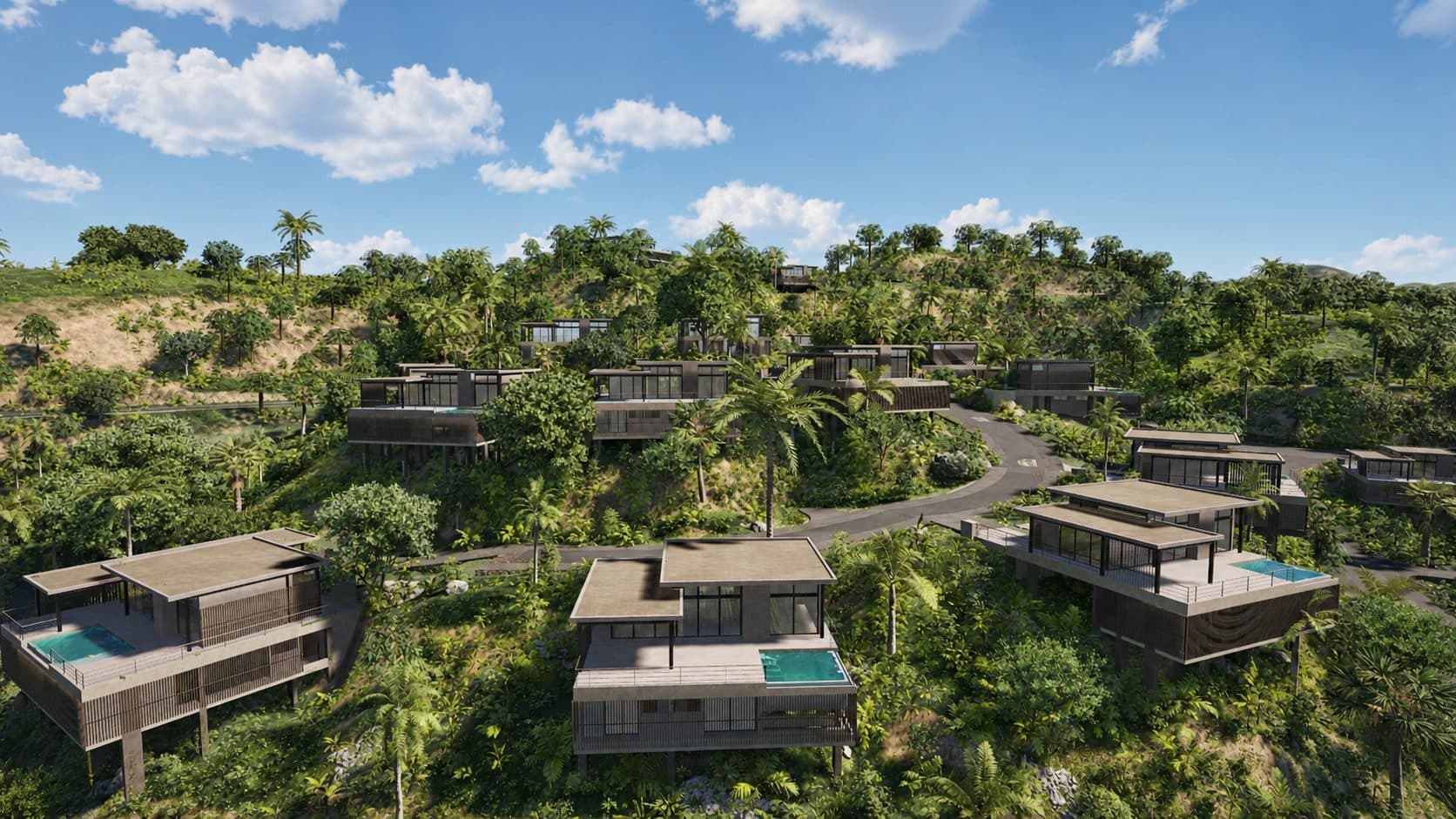
Why did Sienna build in the El Jamito hills above Las Terrenas? Elevation, drainage, ocean views, and biodiversity all pointed to the same 70-acre site.
Sienna chose the El Jamito hills above Las Terrenas because elevation solves problems the coast can't. At 150–300 metres above sea level, the site sits above hurricane surge zones, catches steady trade-wind breezes that cut cooling costs, drains rain naturally down the slope, and delivers ocean views to 90%+ of its lots. The land — 70 acres (29 hectares) in Samaná, Dominican Republic — was selected for how it performs, not just how it looks.
What You Need to Know
- The El Jamito site rises 150–300m above the coast, keeping it above coastal hurricane surge risk.
- 90%+ of Sienna's lots have ocean views; Zone 1 has 28 of 30 lots with sea views.
- Elevation and hillside orientation give a cooler microclimate than beach level — breezes do the work AC otherwise would.
- The 70-acre property preserves native habitat rather than clearing it flat.
- It's 10 minutes to the beaches and centre of Las Terrenas, so seclusion doesn't mean isolation.
Where Is El Jamito, and Why the Samaná Peninsula?
El Jamito is a hillside just inland from Las Terrenas, on the northern Samaná peninsula of the Dominican Republic. The peninsula is one of the greener, less-built corners of the country — a mix of coconut coast, rainforest and small towns rather than wall-to-wall resorts.
Why does that matter for an eco village? Because the surrounding land shapes what you can build. Samaná's rainfall feeds waterfalls like El Limón and keeps the hills genuinely forested, which means a hillside site here comes with mature vegetation and biodiversity already in place — not something you have to plant back after bulldozing.
Las Terrenas itself gives the location its practical edge: 80+ restaurants, international schools, and a community of 6,000+ international residents from 20+ countries. You get hillside quiet with a walkable town 10 minutes downhill. For the fuller picture of the region, the Samaná Peninsula real estate overview covers why Las Terrenas leads the province.
Key takeaway: Samaná offered intact forest and real infrastructure in the same place — rare in the Caribbean.
Why Build on a Hill Instead of the Beach?
Because elevation buys you protection, comfort, and views at once — three things beachfront usually forces you to trade off.
Above the surge zone
The single biggest reason is storm risk. Coastal surge and flooding do the most damage in hurricanes, and both are gravity problems — they hit low ground. Sitting at 150–300m puts Sienna's homes well above the surge zones that threaten beachfront property. Sienna's construction also targets storm resilience directly; the approach is detailed in our guide to hurricane-resistant homes in the Caribbean.
The comfort dividend
Higher ground also means moving air. Trade winds reach the El Jamito slopes more consistently than they reach sheltered beach pockets, and that breeze is what makes passive cooling work — the reason many Sienna homes lean on airflow rather than constant air conditioning. If you want the mechanics, we broke them down in passive cooling for tropical homes.
Key takeaway: The hill delivers safety and a cooler microclimate as a package deal.
How Does Elevation Create a Cooler Microclimate?
Air temperature drops with altitude, and wind exposure rises with it — so a hillside home in Samaná runs cooler than an identical one at sea level. That difference is small in degrees but large in comfort and running costs.
Breeze beats brute force
At beach level, buildings often sit in still, humid air pockets between other structures. On the El Jamito slope, homes are oriented to catch prevailing winds, so cross-ventilation carries heat and humidity out. With 240+ days of sunshine a year, you want that solar gain managed passively — big overhangs, breezeways, shade trees — not fought with a compressor running 12 hours a day.
Picture a Munich remote-worker weighing two villas: one at the beach where the AC never rests, one uphill where a ceiling fan and open shutters do most of the work. Over years of ownership, the second one costs far less to keep comfortable — and every property here ships solar-ready.
Key takeaway: Elevation turns climate control from a monthly bill into a design feature.
What About the Views — and Are They Real?
Yes — 90%+ of Sienna's lots have ocean views, and that figure comes straight from the terrain, not marketing. When you stack homes up a slope facing the sea, each row sits above the one in front, so sightlines to the Atlantic stay open.
In Zone 1, 28 of 30 lots have ocean views. That's a function of how the hillside faces and how the 93 lots across four phases were laid out to preserve view corridors rather than pack density.
Why views hold their value
View lots resell and rent better — that's true from Santorini to Samaná. In Las Terrenas, where Sienna's pre-construction pricing already runs about 20% below comparable completed properties, a documented ocean view strengthens both the rental case and the eventual exit. You can browse the current hillside lots at Sienna to see how orientation maps to price.
Key takeaway: The views are a byproduct of honest topography, and they protect resale value.
How Does the Slope Handle Water and Drainage?
Naturally — which is the whole point. On a hillside, rain follows gravity down and away from foundations, so you avoid the standing-water and flooding headaches that plague flat coastal plots.
Samaná gets real rainfall, so managing it well matters. Rather than fight the water, Sienna's site plan works with the grade: homes on column foundations that let water and roots pass beneath, terraced planting that slows runoff, and cisterns that capture rain for reuse. Our piece on building on sloped terrain explains the column-foundation approach, and cistern design for hillside homes covers how gravity feed turns elevation into free water pressure.
The Dominican Republic requires environmental review for developments like this, and Sienna carries a full set of environmental obligations — detailed in our environmental-license FAQ — that govern how the land is graded and drained.
Key takeaway: Working with the slope prevents flooding instead of patching it later.
What Does the Site Do for Biodiversity?
It keeps most of it. Of the 70 acres, the majority stays as protected natural environment, and the development uses 70% native plant landscaping so the hillside reads as forest, not lawn.
The Caribbean islands are a recognized global biodiversity hotspot — one of only a few dozen worldwide — a status that reflects both exceptional species richness and high threat, as documented by Conservation International's biodiversity-hotspot research. Building lightly on a slope in that context means preserving the flora and fauna already there. A field survey of the property catalogued a substantial native plant community, which we walk through in the 153 plant species of El Jamito.
This is where site selection connects to the wider community vision — the eco village model, shared gardens, and amenities all sit on top of this land-first choice, as our complete guide to Sienna's amenities and community lays out. Samaná's whole appeal, from humpback whales offshore to forested hills, rests on that habitat staying intact, a point echoed by National Geographic's coverage of the peninsula's marine and forest ecosystems.
Key takeaway: The site was chosen so the development could disappear into the landscape rather than replace it.
Frequently Asked Questions
How high is Sienna above sea level?
Sienna's lots sit between 150 and 300 metres elevation in the El Jamito hills, which places them above coastal hurricane surge zones while keeping them 10 minutes from the beaches and centre of Las Terrenas.
Do all Sienna lots have ocean views?
Not every single one, but 90%+ of the lots have ocean views. In Zone 1 specifically, 28 of 30 lots face the sea, thanks to how the hillside is oriented and how view corridors were preserved across the four phases.
Is a hillside site safer than beachfront in a hurricane?
For flooding and storm surge, yes — those are low-ground risks, and elevation removes them. Wind is a separate concern handled through construction standards. Sienna's approach to storm resilience addresses the building side.
Does building on a slope cost more?
Slope construction uses specific methods like column foundations, but it also avoids costs like flood mitigation and heavy AC reliance. We compare the real numbers in does sustainable construction actually cost more.
What is an eco village, exactly?
It's a community designed to live within its landscape — native planting, on-site water capture, solar-ready homes, shared organic gardens — rather than clearing land flat. Sienna applies that model across its 70-acre site above Las Terrenas.
The Foundations, Literally
Site selection is the decision every other decision rests on. Sienna chose the El Jamito hills because 150–300m of elevation delivers hurricane-surge safety, a breeze-cooled microclimate, natural drainage, and ocean views to 90%+ of lots — all on 70 acres of largely preserved Samaná forest, ten minutes from town.
The simplest next step is to come and see it: the Discovery Tour is four nights in Las Terrenas with property visits and the legal and market sessions. From there, the lot map shows exactly where each phase sits on the hill.
The best-built house still can't fix a bad site. This one started with the land.
Stay in the loop
Have questions about this?
Talk to our sales team directly — we'll answer on WhatsApp or by phone.
Written by
Sienna Terrenas Editorial Team
The Sienna Terrenas editorial team covers buying, owning, and living in Las Terrenas, Dominican Republic — from the purchase process and CONFOTUR tax strategy to villa construction and Caribbean community life, drawing on the team's on-the-ground experience in the area. Meet the Sienna Terrenas team.


