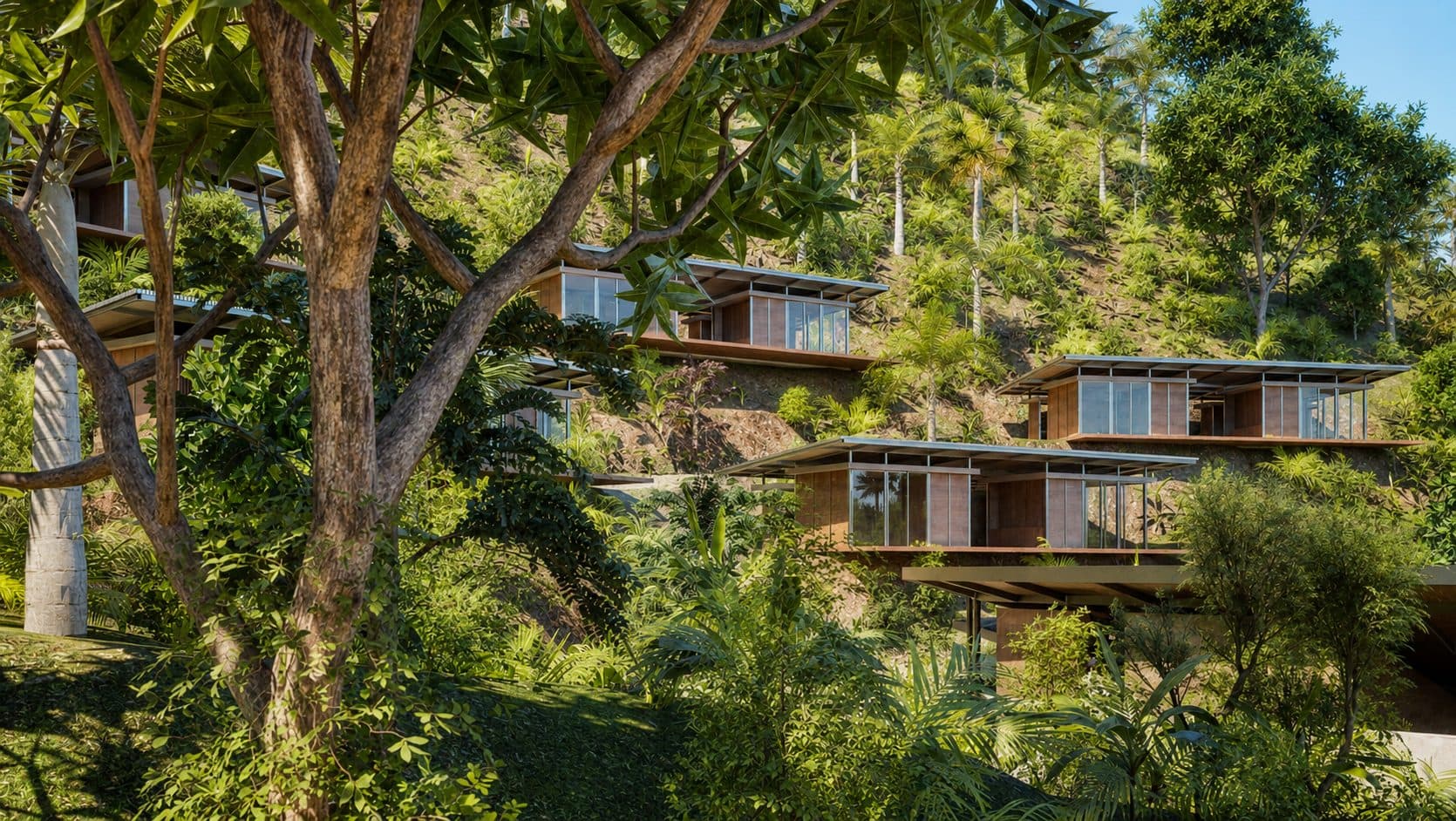
Solaire, eau de pluie, fosse septique, internet — ce que signifie vraiment l'autonomie en République dominicaine, ce qu'elle coûte, et pourquoi le « prêt à l'autonomie » vaut mieux que le « tout autonome » pour presque tout acheteur caribéen.
Vivre en autonomie en République dominicaine est plus pratique que ne l'imaginent la plupart des acheteurs nord-américains ou européens — et plus nuancé que ne le laisse entendre la version YouTube. Le soleil est abondant, la saison de croissance à l'année est bien réelle, et les terrains ruraux sont comparativement abordables. Mais devenir totalement autonome sous les tropiques comporte ses propres modes de défaillance — humidité, corrosion saline, saison des ouragans — et le choix judicieux pour la plupart des acheteurs n'est pas l'autonomie totale, mais un hybride bien conçu.
Ce guide passe en revue ce à quoi ressemble réellement chaque sous-système « autonome » en République dominicaine, quels en sont les coûts réalistes, et où se situent les compromis.
Points clés à retenir
- La République dominicaine bénéficie en moyenne d'environ huit heures d'ensoleillement exploitable par jour, ce qui fait du solaire résidentiel l'une des solutions énergétiques les plus économiques des Caraïbes.
- L'autonomie totale est réalisable, mais nettement plus coûteuse que le « prêt à l'autonomie » — pré-conçu pour le solaire et l'eau de pluie, raccordé au réseau en secours.
- L'eau, et non l'électricité, constitue le problème le plus ardu sur la côte nord. Prévoyez soit un puits profond, soit un système de collecte d'eau de pluie + traitement, et non le seul réseau municipal.
- La saison des ouragans change la donne. Les parcs de batteries, les citernes et les panneaux photovoltaïques nécessitent tous des fixations résistantes aux tempêtes et des enceintes protégées.
- La configuration la plus défendable pour une villa caribéenne est un solaire raccordé au réseau avec batterie de secours, un puits ou système d'eau de pluie traité, une fosse septique sur site, et un internet satellite en relève.
Que signifie réellement « autonome » en République dominicaine ?
L'autonomie sous-entend généralement quatre systèmes distincts : électricité, eau, assainissement et connectivité. En République dominicaine rurale, « autonome » signifie rarement les quatre — cela signifie généralement certains d'entre eux.
Le réseau dominicain (EDENORTE sur la côte nord) est fiable dans les grandes villes et inégal dans les collines qui les surplombent. Des coupures surviennent, surtout en saison des pluies. Cela a appris aux foyers dominicains à être partiellement autosuffisants : citernes, onduleurs et bouteilles de gaz y sont la norme, non l'exception. Ainsi, être « tenté par l'autonomie » en République dominicaine est bien plus proche du niveau de référence local que ce ne le serait à Toronto ou à Berlin.
Un cadre utile : ne vous demandez pas si vous devez devenir autonome. Demandez-vous lequel des quatre sous-systèmes vous pouvez découpler de manière productive du service public, et à quel coût.
Électricité : que pouvez-vous réellement alimenter au solaire ?
Une villa moderne aux normes Sienna — trois chambres, piscine au sel, gamme complète d'électroménagers, avec une climatisation mini-split ajoutée en option — peut fonctionner presque entièrement au solaire avec un dimensionnement adapté. Les raisons sont propres au climat :
- La côte nord dominicaine bénéficie en moyenne d'environ huit heures d'ensoleillement exploitable par jour, toute l'année. C'est plus qu'à peu près partout aux États-Unis continentaux ou en Europe — l'Agence internationale de l'énergie classe l'irradiance solaire des Caraïbes parmi les plus fortes de l'hémisphère occidental.
- L'orientation et la pente des toitures des villas Sienna sont pré-conçues pour accueillir un parc photovoltaïque, y compris les cheminements de gaines, la capacité portante structurelle du toit et l'emplacement des onduleurs. L'activation relève du propriétaire ; l'infrastructure, non. (Voir les pratiques de construction sur le pilier vivre-durable pour le détail côté chantier.)
- Les villas sont livrées de série avec des équipements à faible consommation : éclairage LED dans toute la maison, ventilateurs de plafond avec télécommande dans chaque pièce principale et un chauffe-eau électrique instantané qui ne chauffe que l'eau puisée. Les ventilateurs assurent une bonne part du rafraîchissement, et la climatisation n'est ajoutée que là où le propriétaire le souhaite. Une charge de base plus faible signifie qu'un parc plus petit va plus loin.
Un système photovoltaïque résidentiel de 6 à 10 kW, avec un parc de batteries dimensionné pour les charges du soir, est une configuration typique pour une villa de trois chambres entièrement découplée. Les systèmes hybrides — raccordés au réseau avec batterie de secours — sont moins chers et sans doute plus résilients pour la saison des tempêtes.
Eau : un problème plus ardu que vous ne le pensez
L'électricité fait les gros titres. C'est sur l'eau que la plupart des projets d'autonomie caribéens échouent.
L'eau municipale existe à Las Terrenas, mais elle n'est pas uniformément fiable. L'eau autonome en République dominicaine se résume généralement à l'une de trois options :
| Source | À quoi cela ressemble | Réserves |
|---|---|---|
| Puits profond | Forage, 30-80 m, pompe électrique | Nécessite tests, traitement, pompe résistante aux tempêtes |
| Collecte d'eau de pluie | Captage de toiture, dérivateur de premières eaux, citerne | Nécessite un traitement ; approvisionnement saisonnier |
| Combiné | Puits comme base, eau de pluie en complément | Fiabilité maximale, investissement maximal |
Les trois nécessitent une filtration et un traitement UV ou au chlore pour être potables. L'approche combinée est celle sur laquelle s'arrêtent la plupart des villas caribéennes bien conçues, car elle vous offre une marge lorsqu'une source connaît un mauvais mois.
Chez Sienna en particulier, chaque villa est construite avec son propre système individuel de traitement des eaux usées, conçu lot par lot et inclus dans la villa. Cela retire l'un des quatre sous-systèmes « autonomes » de votre arbre de décision.
Qu'en est-il des eaux usées et des déchets ?
En République dominicaine rurale, une fosse septique correctement conçue avec un champ d'épandage est la solution par défaut. Elle est fiable, bien maîtrisée par les entrepreneurs locaux, et peu coûteuse à entretenir. Le compromis honnête concerne la protection des nappes phréatiques — des champs d'épandage mal réalisés peuvent contaminer un puits.
Le traitement individuel par villa de Sienna est l'une des raisons pour lesquelles le projet répond aux critères du cadre de la Licence environnementale dominicaine — le ministère de l'Environnement maintient le cadre réglementaire que les projets licenciés doivent suivre. Pour un propriétaire, l'effet concret est un sous-système de moins à concevoir, surveiller et remplacer.
Connectivité : le point rédhibitoire moderne
Si vous ne pouvez pas travailler depuis votre villa, l'« autonomie » n'est que du camping. Las Terrenas dispose de la fibre en ville (Claro, Altice) et de services par faisceau hertzien dans les collines. Starlink fait office de relève ; de nombreux travailleurs à distance à Samaná l'utilisent comme connexion principale.
Prévoyez les deux. La fibre lorsqu'elle est disponible, le satellite lorsqu'elle ne l'est pas.
Coût : quel budget prévoir réellement ?
Il est difficile de donner des chiffres honnêtes sans un cahier des charges précis, mais voici des fourchettes de travail pour l'installation d'une villa caribéenne de trois chambres. Considérez-les comme des fourchettes de planification, non comme des devis.
- Solaire raccordé au réseau avec batterie de secours (6-10 kW + 10-15 kWh de stockage) : une dépense significative à cinq chiffres, avec un retour sur investissement de quelques années à un chiffre compte tenu du fort ensoleillement et des tarifs d'électricité dominicains.
- Puits profond avec traitement : cinq chiffres de gamme intermédiaire, plus le remplacement annuel des filtres et des lampes UV.
- Système d'eau de pluie avec citerne : selon la surface de captage de la toiture, cinq chiffres de gamme basse à intermédiaire, plus le traitement.
- Connectivité de secours (Starlink) : faible coût récurrent ; le matériel est un achat unique.
Pour la plupart des acheteurs, le bon point de départ n'est pas le « tout autonome ». C'est le « prêt à l'autonomie » — c'est-à-dire une villa conçue de sorte que tout sous-système puisse être découplé plus tard, à moindre coût de rénovation, lorsque le propriétaire est prêt.
Où l'autonomie a du sens — et où elle n'en a pas
Devenir totalement autonome a du sens lorsque :
- Le coût du raccordement au réseau serait élevé (terrain isolé, éloigné de la ligne)
- Le propriétaire compte être sur place toute l'année et souhaite l'indépendance énergétique et hydrique
- Le site présente la géométrie protégée des tempêtes permettant de monter et de protéger les systèmes
Cela a moins de sens lorsque :
- Le réseau est déjà en limite de propriété
- Le propriétaire n'est pas résident — il existe une complexité opérationnelle à entretenir des systèmes autonomes depuis l'étranger
- L'exposition aux tempêtes rend la redondance (réseau + solaire + batterie) plus sûre que le solaire seul
L'approche Sienna — et notre recommandation pour la plupart des acheteurs — est un solaire raccordé au réseau avec batterie de secours, un puits ou une eau de pluie traités, un traitement des eaux usées sur site ou collectif, et un secours satellite pour la connectivité. Vous obtenez l'essentiel de la résilience et de l'économie énergétique de l'autonomie totale, avec moins de risques en saison des tempêtes et moins de charges d'entretien continu.
En version plus courte
La République dominicaine est l'un des meilleurs marchés caribéens pour vivre en autonomie ou à proximité de celle-ci, principalement parce que le soleil est généreux, les terrains abordables, et l'autosuffisance partielle déjà ancrée dans la norme locale. Le choix judicieux, d'après notre expérience, est d'être conçu pour un découplage total mais de rester hybride en pratique. Cette configuration survit à la saison des tempêtes, simplifie votre vie de propriétaire non résident, et capte tout de même les avantages du solaire et de l'eau de pluie en termes de coûts d'exploitation.
Vous souhaitez voir comment une villa Sienna est pré-conçue pour cela ? Organisez un Discovery Tour, ou lisez le panorama du vivre-durable pour tout le détail côté construction.
Restez informé
Des questions à ce sujet ?
Parlez directement à notre équipe commerciale — nous vous répondrons sur WhatsApp ou par téléphone.
Écrit par
Sienna Terrenas Editorial Team
The Sienna Terrenas editorial team covers buying, owning, and living in Las Terrenas, Dominican Republic — from the purchase process and CONFOTUR tax strategy to villa construction and Caribbean community life, drawing on the team's on-the-ground experience in the area. Rencontrez l'équipe Sienna Terrenas.


