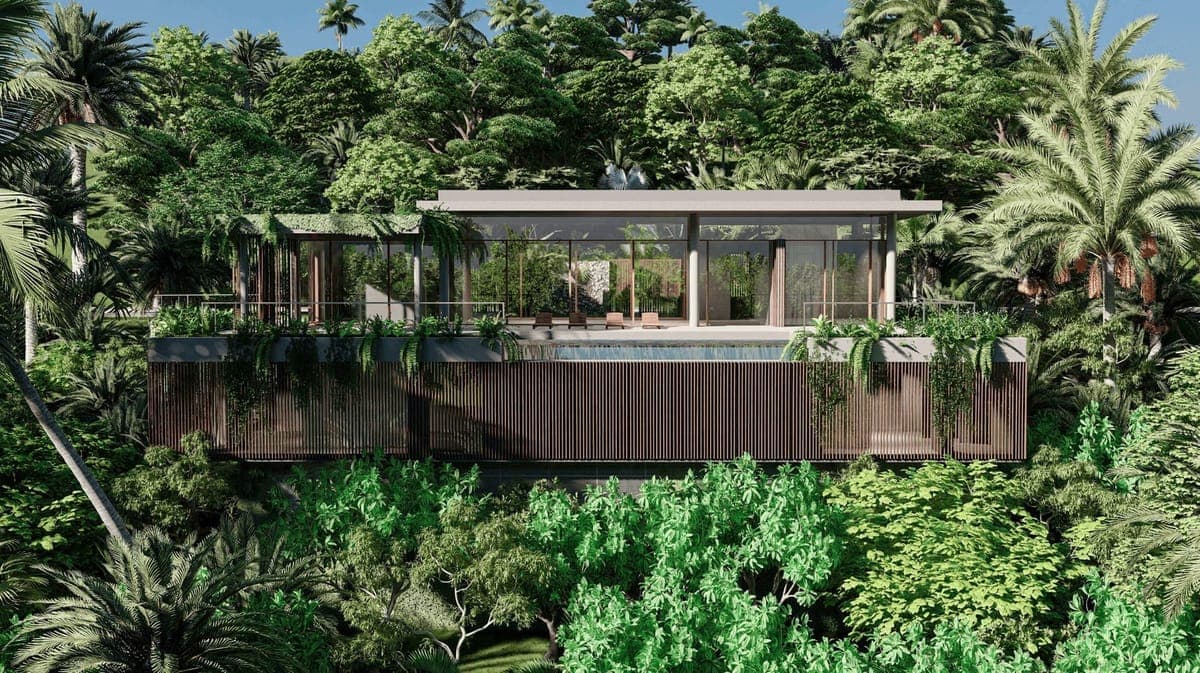
The eco-luxury market has shifted from claims to proof. What premium buyers now ask for — energy and water independence, resilient construction, and documents instead of adjectives.
Ask what high-net-worth buyers want from eco luxury real estate in 2026 and the answers have become remarkably consistent: energy independence, sustainability they can verify in documents rather than brochures, construction built for a changing climate, water autonomy, wellness rooted in nature, and communities that treat land stewardship as an obligation rather than a design theme. The view still matters — it just no longer closes the sale on its own.
Key Takeaways
- The defining shift of 2026: premium buyers ask for proof — environmental licenses, impact studies, certifications — not adjectives.
- Energy and water independence have moved from nice-to-have to baseline expectation in the Caribbean.
- Resilient, passively cooled construction is valued as risk management, not idealism.
- Wellness demand has matured into food, nature access, and quiet rather than spa square footage.
- The bankable part of any "green premium" is lower operating cost and stronger resale positioning — treat headline premium percentages with skepticism.
The Big Shift: From Green Claims to Green Documents
For a decade, "eco" in real estate marketing cost nothing to say. Buyers have noticed. The clearest change in how sophisticated buyers shop today is the paper trail they request before a site visit: the environmental license and the conditions attached to it, the environmental impact study, the community's building rules, the certification body behind any green label.
This is rational self-defense against greenwashing. A development can landscape its entrance with native plants and still discharge untreated wastewater downhill. The difference between the two is never visible in photographs — it lives in documents. Independent marks like LEED or EarthCheck help; so does a government-issued environmental license with binding conditions, because unlike a marketing claim, it carries legal consequences. We cover how the certification landscape works in our guide to green building certifications in the Caribbean.
If a seller cannot produce documents, that is the answer.
Trend 1: Energy Independence as the Baseline
Rooftop solar stopped being a status symbol and became an assumption. In the Caribbean the case is unusually strong: generous year-round sun meets grid infrastructure that varies in reliability and electricity prices that run well above what most North American and European buyers are used to. Solar-plus-storage converts a recurring cost and a recurring annoyance into a fixed, owned asset.
What buyers now evaluate is not whether a property has panels but whether it was designed for them: roof orientation and structure, pre-run conduit, inverter and battery space, and rules that let systems be installed cleanly. The economics — sizing, payback, hurricane-rated mounting — are detailed in our article on solar power in the Caribbean, and for buyers weighing full autonomy, off-grid living in the Dominican Republic separates what is realistic from what is romantic.
Trend 2: Water Autonomy
Water is the quieter half of independence, and in 2026 it gets asked about almost as often as energy. Buyers want to know where water comes from, what happens in a dry stretch, and what happens to wastewater — a question that would have seemed eccentric five years ago.
The answers that satisfy them are physical, not rhetorical: rainwater capture sized to the roof, cistern storage, greywater reuse for irrigation, and wastewater treated on-site instead of quietly released. Our deep dive into rainwater harvesting in the Dominican Republic covers rainfall data, cistern sizing, and real costs.
Trend 3: Construction That Answers the Climate
Premium buyers read climate exposure the way they read a balance sheet. In the Caribbean that means two questions: what happens in a storm, and what does comfort cost in August?
The convincing answers come from engineering, not reassurance — concrete structures and storm-rated roofs on the first question; orientation, cross-ventilation, shading, and thermal mass on the second. Passive design matters twice: it cuts cooling loads every single day, and it keeps a home livable when power fails. Both topics have full guides: hurricane-resistant homes in the Caribbean and sustainable construction practices for the tropics.
Trend 4: Wellness That Grows On Site
The wellness conversation in premium property has matured. The requests that dominate today are quieter: food grown close to the kitchen, walkable land, shade, birdsong, dark skies. Communities with working gardens or collaborative farms answer a question buyers increasingly ask — what will daily life here actually feel like? — better than any render of a gym.
This preference has an investment dimension. Wellness features that depend on staffing and machinery age and cost; ones rooted in land and climate — trails, orchards, breezes — appreciate with the trees.
Trend 5: Stewardship as a Community Feature
The newest entry on buyer checklists is the hardest to fake: what fraction of the land will never be built on, in writing? Buyers have learned that "green community" can mean a golf course. The follow-up questions are specific — how much permanent green space, what happens to watercourses that cross the land, are native species used and protected, who enforces the rules when an owner wants an exception?
Developments that can answer with numbers and enforceable guidelines are scarce, which is precisely why the question works as a filter.
What This Means for Value
An honest reading of the market: industry studies regularly find resale premiums for certified green buildings, but the figures vary widely by market and methodology, and the Caribbean data is thin. Anchoring a purchase decision to a headline premium percentage is not analysis.
The dependable math is different. Passive design, solar, and water autonomy cut operating costs every month of ownership. Documented sustainability widens the future buyer pool and shortens diligence at resale. And in the rental market, verifiable eco-credentials are a genuine positioning advantage with the travelers the Caribbean increasingly attracts. Lower carrying costs plus better exit liquidity is a sturdier thesis than a speculative premium.
How We Apply This at Sienna
Sienna, in the hills above Las Terrenas on the Samaná peninsula, was designed against this checklist — with documents to hand rather than claims.
- Environmental License 0644-26 carries 57 binding environmental obligations; our environmental impact study (EsIA) inventoried 153 plant species on site.
- 67% of the project is permanent green space, and every villa treats its own wastewater with an individual system.
- Per our project standards: all villas are solar-ready, materials are sourced locally wherever practical, and landscaping is 70% native species.
- The development holds CONFOTUR classification under Law 158-01 — up to 15-year property and transfer tax exemptions for buyers.
If your 2026 checklist looks like the one in this article, the fastest way to test us against it is in person: the Discovery Tour puts the documents, the land, and the construction in front of you. Our overview of sustainability in Samaná is a good place to start reading.
Frequently Asked Questions
Do eco features actually increase resale value?
Certified green buildings often show resale premiums in industry studies, but figures vary by market. The reliable gains are lower operating costs throughout ownership, a wider buyer pool, and faster due diligence at exit — the premium, if any, is upside rather than the thesis.
What documents should I ask a developer for?
The environmental license and its conditions, the environmental impact study (EsIA), the community building guidelines, and the basis for any certification claimed. A credible developer produces them quickly; hesitation is information.
Why is the Caribbean well suited to eco-luxury property?
Abundant solar resource, a climate that rewards passive design, and a buyer and rental market that increasingly selects for sustainability. The same conditions that make greenwashing tempting make verified projects stand out.
The eco-luxury market of 2026 rewards one thing above all: being able to prove it. Buyers who ask for documents — and developers who can hand them over — are converging on the same properties.
Stay in the loop
Have questions about this?
Talk to our sales team directly — we'll answer on WhatsApp or by phone.
Written by
Sienna Terrenas Editorial Team
The Sienna Terrenas editorial team covers buying, owning, and living in Las Terrenas, Dominican Republic — from the purchase process and CONFOTUR tax strategy to villa construction and Caribbean community life, drawing on the team's on-the-ground experience in the area. Meet the Sienna Terrenas team.


